燃 (rán) means "to burn; to ignite" in Chinese. It has 16 strokes with the radical 火, and is HSK Level 4.
Rated 4.2/5 in difficulty (advanced).
Harder than 79% of HSK Level 4 characters.
Appears in 3+ common words including 燃烧 (rán shāo), 点燃 (diǎn rán), 燃料 (rán liào).
Due to its 16 strokes, Hanzi Writer's error detection shows 燃 requires focused practice — most learners need 10+ attempts for consistent accuracy.
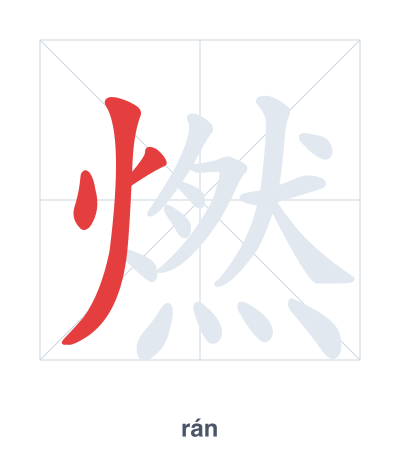
Open Hanzi Writer to see the animated stroke order and practice writing 燃 with real-time feedback.
The character 燃 (rán) is written with 16 strokes. Follow the standard Chinese stroke order: top to bottom, left to right, outside before inside. The radical 火 is one of its key components.
Practice the correct stroke order with the Hanzi Writer app to see animated stroke-by-stroke guidance with real-time feedback.
燃 means to burn; to ignite.
As an HSK Level 4 character, 燃 is an intermediate-level character.
燃 combines the fire radical 火 with 然 (rán), which originally depicted a dog (犬) next to fire (灬) cooking meat (月/肉), symbolizing the act of burning. The addition of 火 reinforces the meaning 'to ignite' or 'to burn'.
💡 Memory Tip: Picture a dog (犬) with four flaming paws (灬) running straight into a big fire (火) — it's totally burning!
木头正在燃烧。
mù tou zhèng zài rán shāo
The wood is burning.
他点燃了蜡烛。
tā diǎn rán le là zhú
He lit the candle.
汽车需要燃料。
qì chē xū yào rán liào
The car needs fuel.
Open Hanzi Writer to see the animated stroke order and practice writing 燃 with real-time feedback.
✨ Animated stroke order · Handwriting recognition · HSK-graded practice · Free to use
燃 combines the radical 火 (fire) on the left with 然 on the right. Fire suggests burning, and 然 itself often means "so" or "correct," but here it provides pronunciation and hints at the idea of something being consumed by fire.