灾 (zāi) means "disaster; calamity" in Chinese. It has 7 strokes with the radical 火, and is HSK Level 5.
Rated 3.5/5 in difficulty (challenging).
Harder than 26% of HSK Level 5 characters.
Appears in 3+ common words including 火灾 (huǒ zāi), 水灾 (shuǐ zāi), 灾难 (zāi nàn).
Due to its 7 strokes, Hanzi Writer's error detection shows 灾 requires focused practice — most learners need 10+ attempts for consistent accuracy.
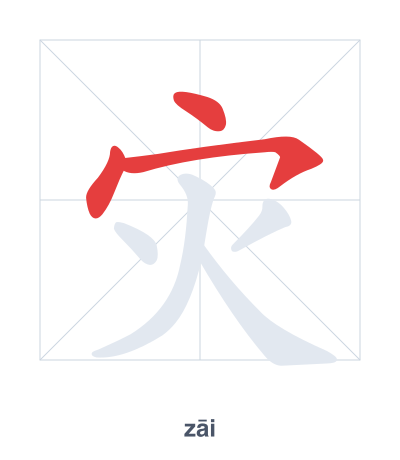
Open Hanzi Writer to see the animated stroke order and practice writing 灾 with real-time feedback.
The character 灾 (zāi) is written with 7 strokes. Follow the standard Chinese stroke order: top to bottom, left to right, outside before inside. The radical 火 is one of its key components.
Practice the correct stroke order with the Hanzi Writer app to see animated stroke-by-stroke guidance with real-time feedback.
灾 means disaster; calamity.
As an HSK Level 5 character, 灾 is an intermediate-level character.
The character 灾 combines the radical 宀 (roof/house) above 火 (fire), literally depicting a house on fire—an ancient and universal disaster. In ancient forms, the character also appeared as 災, combining 水 (water) and 火 (fire) or 戈 (weapon) to represent calamities from flood, fire, or war.
💡 Memory Tip: A roof (宀) catches fire (火), turning your home into a disaster zone.
这里发生了火灾。
zhè lǐ fā shēng le huǒ zāi
A fire broke out here.
那个城市有水灾。
nà ge chéng shì yǒu shuǐ zāi
That city has a flood.
这是一场巨大的灾难。
zhè shì yī cháng jù dà de zāi nàn
This is a huge disaster.
Open Hanzi Writer to see the animated stroke order and practice writing 灾 with real-time feedback.
✨ Animated stroke order · Handwriting recognition · HSK-graded practice · Free to use
灾 combines the radical 火 (fire) under the roof-like component 宀 (mián, meaning roof or shelter). The image is of fire under a roof, which symbolizes a disaster like a house fire. This directly explains why 灾 means disaster or calamity.