窃 (qiè) means "To steal or secretly." in Chinese. It has 9 strokes with the radical 穴, and is HSK Level 7.
Rated 4/5 in difficulty (challenging).
Harder than 44% of HSK Level 7 characters.
Appears in 3+ common words including 偷窃 (tōu qiè), 窃听 (qiè tīng), 窃喜 (qiè xǐ).
Due to its 9 strokes, Hanzi Writer's error detection shows 窃 requires focused practice — most learners need 10+ attempts for consistent accuracy.
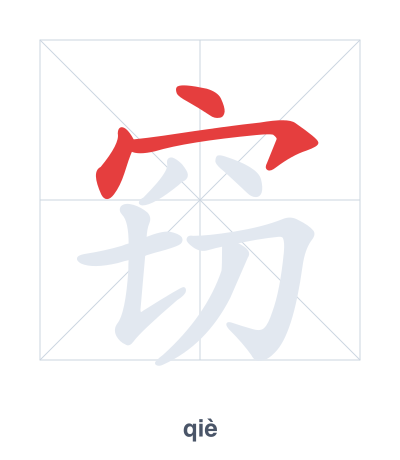
Open Hanzi Writer to see the animated stroke order and practice writing 窃 with real-time feedback.
The character 窃 (qiè) is written with 9 strokes. Follow the standard Chinese stroke order: top to bottom, left to right, outside before inside. The radical 穴 is one of its key components.
Practice the correct stroke order with the Hanzi Writer app to see animated stroke-by-stroke guidance with real-time feedback.
窃 means To steal or secretly..
As an HSK Level 7 character, 窃 is an intermediate-level character.
The character 窃 combines the radical 穴 (cave or hole) with 切 (qiè, meaning 'to cut'), suggesting the act of secretly cutting into a hiding place to steal. Originally from the complex form 竊, which depicted a thief burrowing into a cave, the simplified version retains the imagery of sneaking through a hole to take something.
💡 Memory Tip: Imagine a thief cutting (切) a hole in a cave (穴) to sneak in and steal treasures.
这里发生了偷窃。
zhè lǐ fā shēng le tōu qiè
A theft occurred here.
不要窃听别人说话。
bú yào qiè tīng bié rén shuō huà
Don't eavesdrop on others.
他在心里窃喜。
tā zài xīn lǐ qiè xǐ
He is secretly delighted.
Open Hanzi Writer to see the animated stroke order and practice writing 窃 with real-time feedback.
✨ Animated stroke order · Handwriting recognition · HSK-graded practice · Free to use
The character 窃 is made of 穴 (cave) on top and 切 (to cut) on the bottom. The cave radical relates to hiding or secret places, and cutting suggests breaking in, together giving the idea of stealing or doing something secretly.