遣 (qiǎn) means "To dispatch; to send." in Chinese. It has 13 strokes with the radical 辶, and is HSK Level 7.
Rated 4.2/5 in difficulty (advanced).
Harder than 93% of HSK Level 7 characters.
Appears in 3+ common words including 派遣 (pài qiǎn), 消遣 (xiāo qiǎn), 遣散 (qiǎn sàn).
Due to its 13 strokes, Hanzi Writer's error detection shows 遣 requires focused practice — most learners need 10+ attempts for consistent accuracy.
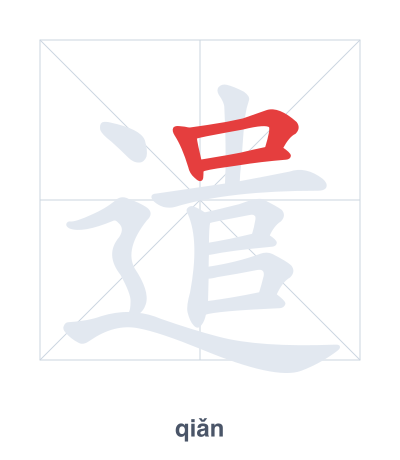
Open Hanzi Writer to see the animated stroke order and practice writing 遣 with real-time feedback.
The character 遣 (qiǎn) is written with 13 strokes. Follow the standard Chinese stroke order: top to bottom, left to right, outside before inside. The radical 辶 is one of its key components.
Practice the correct stroke order with the Hanzi Writer app to see animated stroke-by-stroke guidance with real-time feedback.
遣 means To dispatch; to send..
As an HSK Level 7 character, 遣 is an intermediate-level character.
遣 combines the radical 辶 (walking/movement) with the component 㕣, which originally depicted a hand sending a bundle away, together meaning 'to dispatch or send.'
💡 Memory Tip: Imagine a dispatcher (辶) using a hand to push two stacked boxes (口口) away to send them off.
公司派遣他去上海。
gōng sī pài qiǎn tā qù shàng hǎi
The company dispatched him to Shanghai.
读书是我的消遣。
dú shū shì wǒ de xiāo qiǎn
Reading is my pastime.
工厂遣散了部分工人。
gōng chǎng qiǎn sàn le bù fèn gōng rén
The factory laid off some workers.
Open Hanzi Writer to see the animated stroke order and practice writing 遣 with real-time feedback.
✨ Animated stroke order · Handwriting recognition · HSK-graded practice · Free to use
遣 has a left-right structure. The left part is the radical 辶 (walk), which indicates movement or travel, and the right part is 曹, which provides the approximate sound. Together, the character suggests "to send someone on a journey," fitting its meaning of dispatch or send.