逯 (lù) means "a surname" in Chinese. It has 11 strokes with the radical 辶.
Rated 4.2/5 in difficulty (advanced).
Appears in 3+ common words including 逯姓 (lù xìng), 逯逯 (lù lù), 逯步 (lù bù).
Due to its 11 strokes, Hanzi Writer's error detection shows 逯 requires focused practice — most learners need 10+ attempts for consistent accuracy.
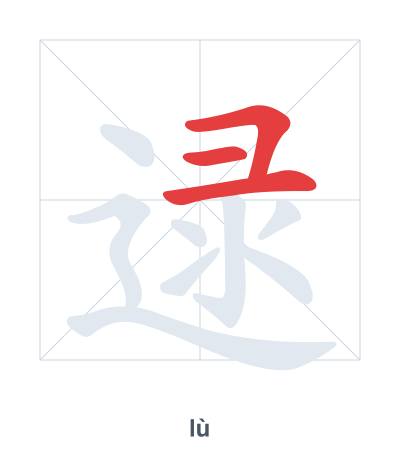
Open Hanzi Writer to see the animated stroke order and practice writing 逯 with real-time feedback.
The character 逯 (lù) is written with 11 strokes. Follow the standard Chinese stroke order: top to bottom, left to right, outside before inside. The radical 辶 is one of its key components.
Practice the correct stroke order with the Hanzi Writer app to see animated stroke-by-stroke guidance with real-time feedback.
逯 means a surname.
The character 逯 is a phono-semantic compound combining the radical 辶 (walking) with 录 (record) as a phonetic component. It originally referred to a place name in ancient China, which later became a surname for people from that area.
💡 Memory Tip: Picture yourself walking (辶) to a genealogy record (录) to find your ancestral surname 逯.
我的老师姓逯。
wǒ de lǎo shī xìng lù
My teacher's surname is Lu.
他逯逯地走在后面。
tā lù lù dì zǒu zài hòu miàn
He walked slowly behind.
他在林中慢速逯步。
tā zài lín zhōng màn sù lù bù
He is walking slowly in the woods.
Open Hanzi Writer to see the animated stroke order and practice writing 逯 with real-time feedback.
✨ Animated stroke order · Handwriting recognition · HSK-graded practice · Free to use
逯 is made of the radical 辶 (walking) on the left and the component 录 (lù, meaning to record) on the right. The radical suggests movement, but the character's main meaning is a surname, so the parts mainly give a hint to the pronunciation rather than the meaning.