散 (sǎn/sàn) means "to scatter / to disperse / loose" in Chinese. It has 12 strokes with the radical 攵, and is HSK Level 3.
Rated 4.2/5 in difficulty (advanced).
Harder than 79% of HSK Level 3 characters.
Appears in 4+ common words including 分散 (fēn sàn), 散步 (sàn bù), 松散 (sōng sǎn).
Due to its 12 strokes, Hanzi Writer's error detection shows 散 requires focused practice — most learners need 10+ attempts for consistent accuracy.
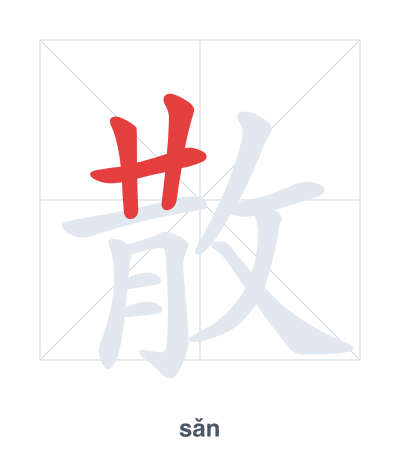
Open Hanzi Writer to see the animated stroke order and practice writing 散 with real-time feedback.
The character 散 (sǎn/sàn) is written with 12 strokes. Follow the standard Chinese stroke order: top to bottom, left to right, outside before inside. The radical 攵 is one of its key components.
Practice the correct stroke order with the Hanzi Writer app to see animated stroke-by-stroke guidance with real-time feedback.
散 means to scatter / to disperse / loose.
This is a polyphonic character with readings: sǎn, sàn.
As an HSK Level 3 character, 散 is an intermediate-level character.
散 combines the radical 攵 (action) with 㪔, a component that originally depicted hemp fibers being pulled apart. Together, they convey the action of scattering or dispersing, like separating fibers into loose strands.
💡 Memory Tip: Picture a hand (攵) scattering grass (艹) and a crescent moon (月) into the wind.
大家的注意力容易被窗外的噪音分散。
dà jiā de zhù yì lì róng yì bèi chuāng wài de zào yīn fēn sàn
Everyone's attention is easily distracted by the noise outside the window.
晚饭后,爷爷喜欢去公园散步。
wǎn fàn hòu yé yé xǐ huān qù gōng yuán sàn bù
After dinner, Grandpa likes to go for a walk in the park.
这种土质非常松散,不适合种树。
zhè zhǒng tǔ zhì fēi cháng sōng sǎn bú shì hé zhòng shù
This soil is very loose and not suitable for planting trees.
他的散文写得非常优美动人。
tā de sǎn wén xiě dé fēi cháng yōu měi dòng rén
His prose is written very beautifully and touchingly.
Open Hanzi Writer to see the animated stroke order and practice writing 散 with real-time feedback.
✨ Animated stroke order · Handwriting recognition · HSK-graded practice · Free to use
散 is made of three parts: 艹 (grass) on top, 月 (meat or moon) in the middle, and 攵 (a hand with a stick, showing action) on the right. Together they suggest something being broken apart or loosened, like grass or meat scattered by force. The radical 攵 indicates that the character involves an action or process.