Hanzi Writer

How to Write 逭 (huàn) — Meaning “to escape”

huàn 11 strokes Radical: 辶

逭 (huàn) means "to escape" in Chinese. It has 11 strokes with the radical 辶.

Rated 4.2/5 in difficulty (advanced).

Appears in 3+ common words including 逃逭 (táo huàn), 逭暑 (huàn shǔ), 逭责 (huàn zé).

Due to its 11 strokes, Hanzi Writer's error detection shows 逭 requires focused practice — most learners need 10+ attempts for consistent accuracy.
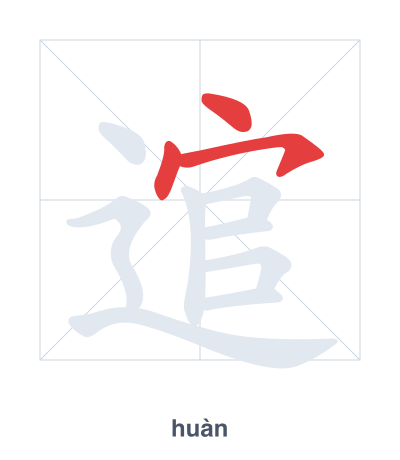
Stroke order practice for 逭 - huàn

Practice Writing 逭 (huàn)

Open Hanzi Writer to see the animated stroke order and practice writing 逭 with real-time feedback.

The character (huàn) is written with 11 strokes. Follow the standard Chinese stroke order: top to bottom, left to right, outside before inside. The radical is one of its key components.

Practice the correct stroke order with the Hanzi Writer app to see animated stroke-by-stroke guidance with real-time feedback.

means to escape.

Character
Pinyinhuàn (huan)
Meaningto escape
Strokes11
Radical
Difficulty4.2/5

逭 is a phono-semantic compound: the radical 辶 (walk) indicates movement, and 奐 (huàn, meaning 'exchange' or 'bright') provides the phonetic. To escape implies hurriedly moving away or changing direction to avoid capture.

💡 Memory Tip: Picture a person walking (辶) who spots a hound (奐 resembling a dog with ears) and must quickly escape.

táo huàn
to escape; to evade (literary)
huàn shǔ
to escape the summer heat
huàn zé
to evade responsibility

他想逃逭自己的责任。

tā xiǎng táo huàn zì jǐ de zé rèn

He wants to evade his responsibility.

我们去山里逭暑。

wǒ men qù shān lǐ huàn shǔ

Let's go to the mountains to avoid the heat.

这个错误无法逭责。

zhè ge cuò wù wú fǎ huàn zé

This mistake cannot be excused.

Character Pinyin Strokes Radical
(current) huàn 11
yòu 9
9
bèng 9
Stroke order practice for 逭 - huàn

Practice Writing 逭 (huàn)

Open Hanzi Writer to see the animated stroke order and practice writing 逭 with real-time feedback.

✨ Animated stroke order · Handwriting recognition · HSK-graded practice · Free to use

Frequently Asked Questions about 逭

逭 consists of the radical 辶 (walk, movement) on the left, and the phonetic component 奐 (huàn) on the right. The radical suggests moving away or fleeing, while 奐 provides the pronunciation. Together they form the idea of escaping by moving away.

Characters with Radical 辶

Other 11-Stroke Characters