逮 (dǎi/dài) means "to catch" in Chinese. It has 11 strokes with the radical 辶, and is HSK Level 7.
Rated 4.2/5 in difficulty (advanced).
Harder than 93% of HSK Level 7 characters.
Appears in 3+ common words including 逮老鼠 (dǎi lǎo shǔ), 逮住 (dǎi zhù), 逮捕 (dài bǔ).
Due to its 11 strokes, Hanzi Writer's error detection shows 逮 requires focused practice — most learners need 10+ attempts for consistent accuracy.
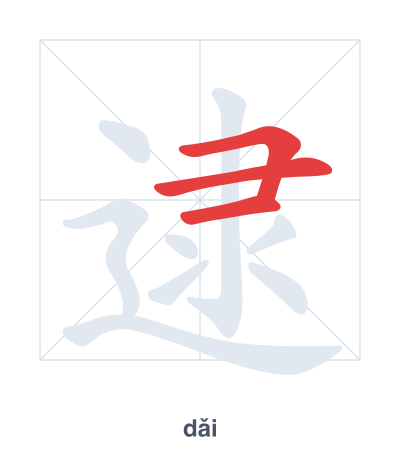
Open Hanzi Writer to see the animated stroke order and practice writing 逮 with real-time feedback.
The character 逮 (dǎi/dài) is written with 11 strokes. Follow the standard Chinese stroke order: top to bottom, left to right, outside before inside. The radical 辶 is one of its key components.
Practice the correct stroke order with the Hanzi Writer app to see animated stroke-by-stroke guidance with real-time feedback.
逮 means to catch.
This is a polyphonic character with readings: dǎi, dài.
As an HSK Level 7 character, 逮 is an intermediate-level character.
逮 is a compound character where 辶 (walking) indicates movement and 隶 (originally a hand seizing an animal's tail) provides the meaning of catching. Together, they depict chasing and grabbing something.
💡 Memory Tip: Picture a detective walking swiftly (辶) to grab a thief by the tail (隶) to catch him.
那只调皮的猫每天晚上都在谷仓里逮老鼠。
nà zhǐ tiáo pí de māo měi tiān wǎn shàng dōu zài gǔ cāng lǐ dǎi lǎo shǔ 。
The naughty cat catches mice in the barn every night.
警察迅速出击,终于在巷子里逮住了嫌犯。
jǐng chá xùn sù chū jī zhōng yú zài xiàng zi lǐ dǎi zhù le xián fàn
The police acted quickly and finally caught the suspect in the alley.
法院已经正式签发了对犯罪嫌疑人的逮捕令。
fǎ yuàn yǐ jīng zhèng shì qiān fā le duì fàn zuì xián yí rén de dài bǔ lìng
The court has officially issued an arrest warrant for the suspect.
Open Hanzi Writer to see the animated stroke order and practice writing 逮 with real-time feedback.
✨ Animated stroke order · Handwriting recognition · HSK-graded practice · Free to use
The left radical 辶 indicates movement or walking, while the right part 隶 gives the sound and suggests reaching or capturing something. Together, 逮 means "to catch" as in moving to seize an animal or person.