停 (tíng) means "to stop; to park; to halt" in Chinese. It has 11 strokes with the radical 亻, and is HSK Level 2.
Rated 3.4/5 in difficulty (challenging).
Harder than 56% of HSK Level 2 characters.
Appears in 3+ common words including 停车 (tíng chē), 停止 (tíng zhǐ), 停电 (tíng diàn).
Due to its 11 strokes, Hanzi Writer's error detection shows 停 requires focused practice — most learners need 10+ attempts for consistent accuracy.
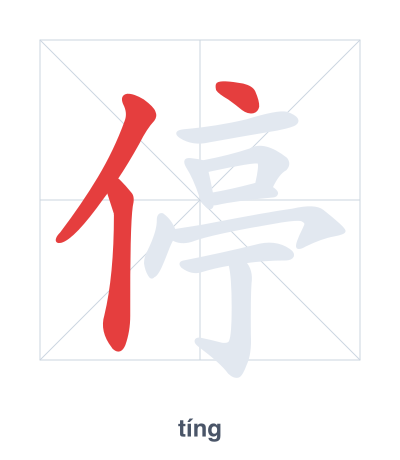
Open Hanzi Writer to see the animated stroke order and practice writing 停 with real-time feedback.
The character 停 (tíng) is written with 11 strokes. Follow the standard Chinese stroke order: top to bottom, left to right, outside before inside. The radical 亻 is one of its key components.
Practice the correct stroke order with the Hanzi Writer app to see animated stroke-by-stroke guidance with real-time feedback.
停 means to stop; to park; to halt.
As an HSK Level 2 character, 停 is among the first characters beginners learn.
停 combines the radical 亻 (person) with 亭 (pavilion). The character depicts a person (亻) pausing at a roadside pavilion (亭), reflecting the act of stopping or parking. The phonetic component 亭 also hints at the sound tíng.
💡 Memory Tip: A person (亻) stands under a tall pavilion (亭) with a roof and pillar, halting their journey for a rest.
门口可以停车吗?
mén kǒu kě yǐ tíng chē ma
Can I park at the entrance?
雨已经停止了。
yǔ yǐ jīng tíng zhǐ le
The rain has already stopped.
昨天晚上停电了。
zuó tiān wǎn shàng tíng diàn le
There was a power outage last night.
Open Hanzi Writer to see the animated stroke order and practice writing 停 with real-time feedback.
✨ Animated stroke order · Handwriting recognition · HSK-graded practice · Free to use
停 is composed of the radical 亻 (person) on the left and the phonetic component 亭 (pavilion) on the right. The person radical suggests human action, and the pavilion is a place where travelers stop to rest, combining to mean 'to stop' or 'to park.'