墓 (mù) means "tomb" in Chinese. It has 13 strokes with the radical 土, and is HSK Level 6.
Rated 4.2/5 in difficulty (advanced).
Harder than 56% of HSK Level 6 characters.
Appears in 3+ common words including 墓地 (mù dì), 扫墓 (sǎo mù), 墓碑 (mù bēi).
Due to its 13 strokes, Hanzi Writer's error detection shows 墓 requires focused practice — most learners need 10+ attempts for consistent accuracy.
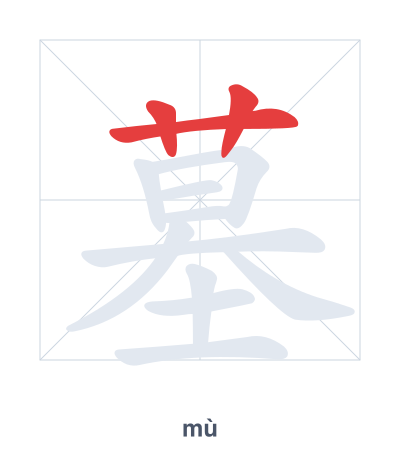
Open Hanzi Writer to see the animated stroke order and practice writing 墓 with real-time feedback.
The character 墓 (mù) is written with 13 strokes. Follow the standard Chinese stroke order: top to bottom, left to right, outside before inside. The radical 土 is one of its key components.
Practice the correct stroke order with the Hanzi Writer app to see animated stroke-by-stroke guidance with real-time feedback.
墓 means tomb.
As an HSK Level 6 character, 墓 is an intermediate-level character.
墓 combines 土 (earth) with 莫, which originally depicted the sun setting in grass (meaning 'dusk' or 'to cover'). Together, they evoke a mound of earth covering a burial place—a tomb hidden beneath the soil and vegetation.
💡 Memory Tip: Picture the sun setting in grass (莫) over a pile of earth (土), marking the hidden tomb where someone rests forever.
他去墓地看朋友。
tā qù mù dì kàn péng yǒu
He went to the cemetery to visit a friend.
清明节我们要去扫墓。
qīng míng jié wǒ men yào qù sǎo mù
We are going to sweep the tombs on Tomb-Sweeping Day.
墓碑上写着他的名字。
mù bēi shàng xiě zhe tā de míng zì
His name is written on the tombstone.
Open Hanzi Writer to see the animated stroke order and practice writing 墓 with real-time feedback.
✨ Animated stroke order · Handwriting recognition · HSK-graded practice · Free to use
墓 is made of 莫 on top and 土 (earth) below. The top part 莫 originally meant 'sunset' or 'not,' but here it provides a phonetic hint, while 土 directly shows that a tomb is built in or with earth. Together, they create the meaning of a burial place underground.