摸 (mō) means "to touch" in Chinese. It has 13 strokes with the radical 扌, and is HSK Level 4.
Rated 4.2/5 in difficulty (advanced).
Harder than 72% of HSK Level 4 characters.
Appears in 3+ common words including 触摸 (chù mō), 摸索 (mō suǒ), 抚摸 (fǔ mō).
Due to its 13 strokes, Hanzi Writer's error detection shows 摸 requires focused practice — most learners need 10+ attempts for consistent accuracy.
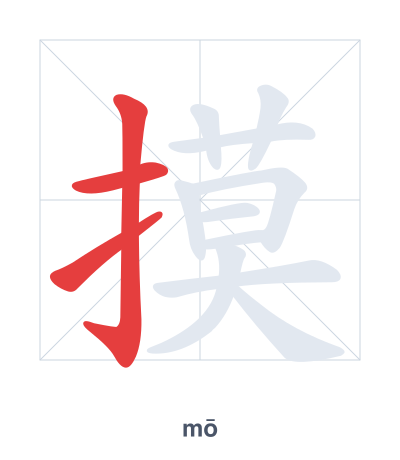
Open Hanzi Writer to see the animated stroke order and practice writing 摸 with real-time feedback.
The character 摸 (mō) is written with 13 strokes. Follow the standard Chinese stroke order: top to bottom, left to right, outside before inside. The radical 扌 is one of its key components.
Practice the correct stroke order with the Hanzi Writer app to see animated stroke-by-stroke guidance with real-time feedback.
摸 means to touch.
As an HSK Level 4 character, 摸 is an intermediate-level character.
摸 is a phono-semantic compound: the hand radical 扌 indicates the action of touching, while the phonetic component 莫 (mò, originally depicting the sun setting in grass, evoking darkness) hints at groping or feeling one's way in the dark.
💡 Memory Tip: Picture your hand (扌) stretching out to feel a giant sunflower (莫 = grass + sun + big) hidden in the dark.
请触摸屏幕。
qǐng chù mō píng mù 。
Please touch the screen.
他在黑暗中摸索。
tā zài hēi àn zhōng mō suǒ
He is fumbling in the dark.
她在抚摸小猫。
tā zài fǔ mō xiǎo māo
She is petting the kitten.
Open Hanzi Writer to see the animated stroke order and practice writing 摸 with real-time feedback.
✨ Animated stroke order · Handwriting recognition · HSK-graded practice · Free to use
The left component is 扌, the hand radical, showing that the action involves the hand. The right side is 莫, which gives the character its pronunciation mō and also hints at feeling in darkness, as 莫 can mean "do not" (like when you cannot see, you touch to explore). Together, 摸 means to touch or feel with the hand.