猛 (měng) means "Fierce / Sudden" in Chinese. It has 11 strokes with the radical 犭, and is HSK Level 6.
Rated 4.2/5 in difficulty (advanced).
Harder than 77% of HSK Level 6 characters.
Appears in 3+ common words including 猛烈 (měng liè), 凶猛 (xiōng měng), 猛然 (měng rán).
Due to its 11 strokes, Hanzi Writer's error detection shows 猛 requires focused practice — most learners need 10+ attempts for consistent accuracy.
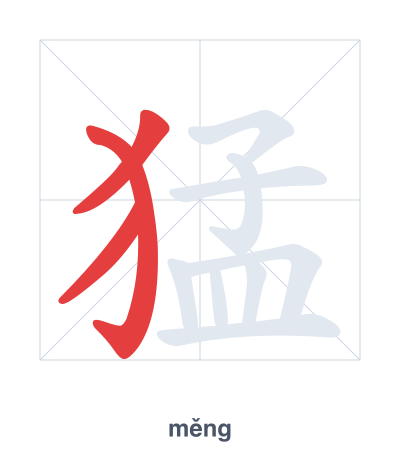
Open Hanzi Writer to see the animated stroke order and practice writing 猛 with real-time feedback.
The character 猛 (měng) is written with 11 strokes. Follow the standard Chinese stroke order: top to bottom, left to right, outside before inside. The radical 犭 is one of its key components.
Practice the correct stroke order with the Hanzi Writer app to see animated stroke-by-stroke guidance with real-time feedback.
猛 means Fierce / Sudden.
As an HSK Level 6 character, 猛 is an intermediate-level character.
猛 combines the radical 犭 (dog) with 孟 (firstborn/young), suggesting a young dog that is fierce and sudden in its actions. The dog radical points to an animal's aggressive nature, while 孟 adds the sense of youthful vigor, together creating the idea of a sudden, intense fierceness.
💡 Memory Tip: Picture a young dog (犭) suddenly leaping (孟) at you with a fierce snarl, catching you off guard.
外面的风刮得很猛烈。
wài miàn de fēng guā dé hěn měng liè
The wind is blowing fiercely outside.
这只老虎看起来很凶猛。
zhè zhǐ lǎo hǔ kàn qǐ lái hěn xiōng měng
This tiger looks very fierce.
他猛然想起了这件事。
tā měng rán xiǎng qǐ le zhè jiàn shì
He suddenly remembered this matter.
Open Hanzi Writer to see the animated stroke order and practice writing 猛 with real-time feedback.
✨ Animated stroke order · Handwriting recognition · HSK-graded practice · Free to use
猛 is formed with the radical 犭 (dog/animal) on the left, which indicates an animal-related meaning. The right part 孟 (mèng, first-born) provides a phonetic hint for the pronunciation měng. Combined, the radical suggests a fierce animal, linking to the meaning "fierce" or "violent".