狊 (jú) means "To stare or look with wide eyes." in Chinese. It has 9 strokes with the radical 犭.
Rated 4/5 in difficulty (challenging).
Appears in 3+ common words including 狊狊 (jú jú), 狊然 (jú rán), 狊视 (jú shì).
Due to its 9 strokes, Hanzi Writer's error detection shows 狊 requires focused practice — most learners need 10+ attempts for consistent accuracy.
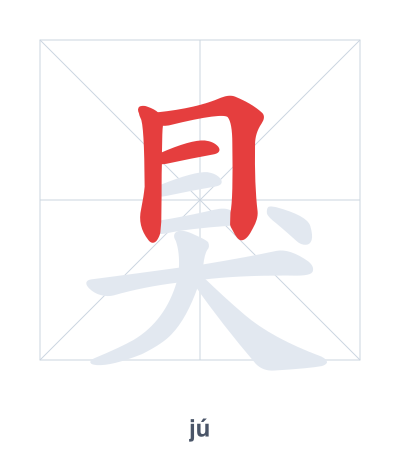
Open Hanzi Writer to see the animated stroke order and practice writing 狊 with real-time feedback.
The character 狊 (jú) is written with 9 strokes. Follow the standard Chinese stroke order: top to bottom, left to right, outside before inside. The radical 犭 is one of its key components.
Practice the correct stroke order with the Hanzi Writer app to see animated stroke-by-stroke guidance with real-time feedback.
狊 means To stare or look with wide eyes..
狊 combines the radical 犭 (dog) with 目 (eye), depicting a dog staring with wide, intense eyes. This highlights the meaning of gazing fixedly or with great attention.
💡 Memory Tip: Imagine a dog (犭) with eyes (目) so wide and staring that it looks like two big round lenses—狊—as if it's frozen in a staring contest.
他狊狊地盯着四周。
tā jú jú dì dīng zhe sì zhōu
He stared around warily.
他狊然一惊,停下了步。
tā jú rán yī jīng tíng xià le bù
He was startled and stopped in his tracks.
野兽在黑暗中狊视。
yě shòu zài hēi àn zhōng jú shì
The wild beast stared in the dark.
Open Hanzi Writer to see the animated stroke order and practice writing 狊 with real-time feedback.
✨ Animated stroke order · Handwriting recognition · HSK-graded practice · Free to use
The character 狊 consists of the dog radical 犭 on the left and a right component that resembles two eyes (目 and 目) stacked together. This structure suggests a dog staring with wide-open eyes, which matches the meaning "to stare or look with wide eyes."