狡 (jiǎo) means "Cunning; crafty" in Chinese. It has 9 strokes with the radical 犭, and is HSK Level 7.
Rated 4/5 in difficulty (challenging).
Harder than 42% of HSK Level 7 characters.
Appears in 3+ common words including 狡猾 (jiǎo huá), 狡辩 (jiǎo biàn), 狡诈 (jiǎo zhà).
Due to its 9 strokes, Hanzi Writer's error detection shows 狡 requires focused practice — most learners need 10+ attempts for consistent accuracy.
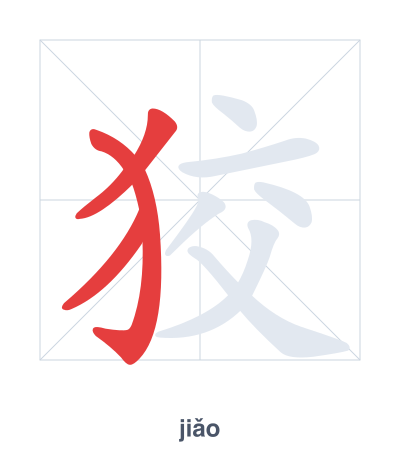
Open Hanzi Writer to see the animated stroke order and practice writing 狡 with real-time feedback.
The character 狡 (jiǎo) is written with 9 strokes. Follow the standard Chinese stroke order: top to bottom, left to right, outside before inside. The radical 犭 is one of its key components.
Practice the correct stroke order with the Hanzi Writer app to see animated stroke-by-stroke guidance with real-time feedback.
狡 means Cunning; crafty.
As an HSK Level 7 character, 狡 is an intermediate-level character.
The character 狡 combines the dog radical (犭) on the left, indicating an animal, with 交 (jiāo, meaning 'to cross' or 'intertwine') on the right. This suggests a dog that twists or crosses boundaries, reflecting cunning and crafty behavior. Originally it referred to a young dog, but the meaning shifted to describe a sly, tricky nature.
💡 Memory Tip: Picture a sneaky dog (犭) crossing (交) a fence to steal a bone, outsmarting the owner with its crafty move.
狐狸是非常狡猾的。
hú lí shì fēi cháng jiǎo huá de
Foxes are extremely cunning.
犯错后不要再狡辩了。
fàn cuò hòu bú yào zài jiǎo biàn le
Don't make excuses after making a mistake.
这个商人非常狡诈。
zhè ge shāng rén fēi cháng jiǎo zhà
This businessman is very deceitful.
Open Hanzi Writer to see the animated stroke order and practice writing 狡 with real-time feedback.
✨ Animated stroke order · Handwriting recognition · HSK-graded practice · Free to use
The character 狡 has two parts: the left radical 犭 (dog) and the right component 交 (jiāo, to cross or mix). Since 犭 is often used in characters related to animal behavior, and 交 suggests twisting or crossing, together they create the idea of a twisted or tricky animal, which leads to the meaning 'cunning'.