巾 (jīn) means "towel / cloth" in Chinese. It has 3 strokes with the radical 巾, and is HSK Level 4.
Rated 2.2/5 in difficulty (moderate).
Harder than 3% of HSK Level 4 characters.
Appears in 3+ common words including 毛巾 (máo jīn), 纸巾 (zhǐ jīn), 围巾 (wéi jīn).
Hanzi Writer's stroke validation shows learners typically need 5-8 attempts to write 巾 with correct proportion and order.
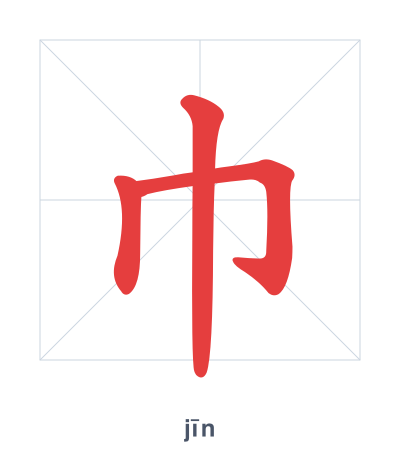
Open Hanzi Writer to see the animated stroke order and practice writing 巾 with real-time feedback.
The character 巾 (jīn) is written with 3 strokes. Follow the standard Chinese stroke order: top to bottom, left to right, outside before inside. The radical 巾 is one of its key components.
Practice the correct stroke order with the Hanzi Writer app to see animated stroke-by-stroke guidance with real-time feedback.
巾 means towel / cloth.
As an HSK Level 4 character, 巾 is an intermediate-level character.
The character 巾 is a pictograph of a hanging cloth or towel, with ancient oracle bone script depicting a cloth suspended from a pole or a piece of cloth with folds. The modern form retains the basic shape of a rectangular cloth with a vertical line representing the fold or hanging point.
💡 Memory Tip: Picture a towel hanging on a hook: the top horizontal stroke is the hook, the vertical line is the towel's fold, and the two sides are the cloth.
请给我一条毛巾。
qǐng gěi wǒ yī tiáo máo jīn
Please give me a towel.
你有纸巾吗?
nǐ yǒu zhǐ jīn ma
Do you have any tissues?
冬天要戴围巾。
dōng tiān yào dài wéi jīn
You should wear a scarf in winter.
Open Hanzi Writer to see the animated stroke order and practice writing 巾 with real-time feedback.
✨ Animated stroke order · Handwriting recognition · HSK-graded practice · Free to use
巾 is a simple pictograph that looks like a hanging piece of cloth or a towel. Its shape directly represents the original meaning of a cloth or scarf, with no separate radical components.