巿 (fú) means "ceremonial knee-pad (archaic)" in Chinese. It has 4 strokes with the radical 巾.
Rated 2.7/5 in difficulty (moderate).
Appears in 3+ common words including 巿𫖒 (fú 𫖒), 朱巿 (zhū fú), 巿佩 (fú pèi).
Hanzi Writer's stroke validation shows learners typically need 5-8 attempts to write 巿 with correct proportion and order.
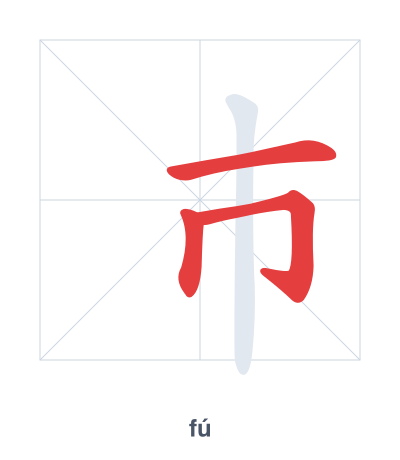
Open Hanzi Writer to see the animated stroke order and practice writing 巿 with real-time feedback.
The character 巿 (fú) is written with 4 strokes. Follow the standard Chinese stroke order: top to bottom, left to right, outside before inside. The radical 巾 is one of its key components.
Practice the correct stroke order with the Hanzi Writer app to see animated stroke-by-stroke guidance with real-time feedback.
巿 means ceremonial knee-pad (archaic).
The character 巿 is a pictograph of an ancient ceremonial knee-pad made of cloth. Its form shows a piece of cloth (巾) with a horizontal band at the top, representing the string used to tie it around the leg. This knee-pad was worn as part of formal attire in early Chinese rituals.
💡 Memory Tip: Picture a cloth (巾) with a belt (horizontal line) tied around your knee as a pad.
他穿着巿𫖒。
tā chuān zhe fú 𫖒 。
He is wearing a ceremonial knee-cover.
这是一个朱巿。
zhè shì yí gè zhū fú
This is a red ceremonial apron.
他佩戴着巿佩。
tā pèi dài zhe fú pèi
He is wearing a ceremonial knee-cover ornament.
Open Hanzi Writer to see the animated stroke order and practice writing 巿 with real-time feedback.
✨ Animated stroke order · Handwriting recognition · HSK-graded practice · Free to use
巿 consists of the radical 巾 (cloth) at the bottom, which hints at its association with clothing. The top part is a horizontal line with a vertical stroke, possibly depicting the shape of a knee-pad worn over cloth. This combination shows it is a cloth item used ceremonially on the knee.