帅 (shuài) means "handsome; cool" in Chinese. It has 5 strokes with the radical 巾, and is HSK Level 4.
Rated 2.9/5 in difficulty (moderate).
Harder than 11% of HSK Level 4 characters.
Appears in 3+ common words including 帅 (shuài), 帅哥 (shuài gē), 帅气 (shuài qì).
Hanzi Writer's stroke validation shows learners typically need 5-8 attempts to write 帅 with correct proportion and order.
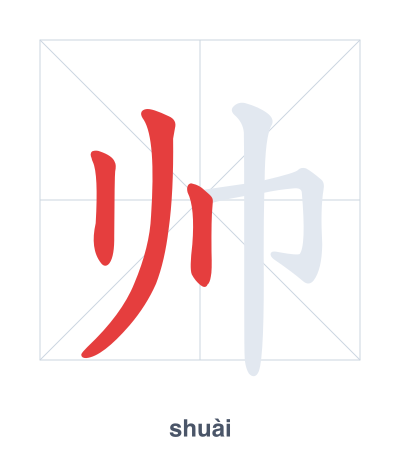
Open Hanzi Writer to see the animated stroke order and practice writing 帅 with real-time feedback.
The character 帅 (shuài) is written with 5 strokes. Follow the standard Chinese stroke order: top to bottom, left to right, outside before inside. The radical 巾 is one of its key components.
Practice the correct stroke order with the Hanzi Writer app to see animated stroke-by-stroke guidance with real-time feedback.
帅 means handsome; cool.
As an HSK Level 4 character, 帅 is an intermediate-level character.
The character 帅 is the simplified form of 帥, which originally depicted a hand holding a cloth flag (巾) on a pole, symbolizing a military commander. Over time, the meaning shifted to 'handsome' or 'cool' by association with a commanding and attractive presence. The radical 巾 (cloth/turban) hints at the original banner connection.
💡 Memory Tip: Picture a cool guy with a cloth headband (巾) and a slick sideways hairstyle (the right stroke) looking handsome.
他长得很帅。
tā zhǎng dé hěn shuài
He is very handsome.
那个帅哥是谁?
nà ge shuài gē shì shuí
Who is that handsome guy?
他的衣服很帅气。
tā de yī fú hěn shuài qì
His clothes are very stylish.
Open Hanzi Writer to see the animated stroke order and practice writing 帅 with real-time feedback.
✨ Animated stroke order · Handwriting recognition · HSK-graded practice · Free to use
帅 has two parts: the left side is two dots (冫) and the right side is 巾 (cloth). The original traditional character 帥 meant a military commander who wore a cloth headband, so the cloth radical connects to leadership. Today the meaning "handsome" developed from the idea of a commander looking impressive.