币 (bì) means "currency / money" in Chinese. It has 4 strokes with the radical 巾, and is HSK Level 3.
Rated 2.7/5 in difficulty (moderate).
Harder than 13% of HSK Level 3 characters.
Appears in 3+ common words including 钱币 (qián bì), 货币 (huò bì), 硬币 (yìng bì).
Hanzi Writer's stroke validation shows learners typically need 5-8 attempts to write 币 with correct proportion and order.
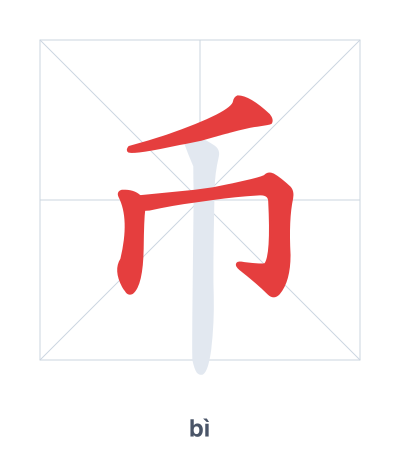
Open Hanzi Writer to see the animated stroke order and practice writing 币 with real-time feedback.
The character 币 (bì) is written with 4 strokes. Follow the standard Chinese stroke order: top to bottom, left to right, outside before inside. The radical 巾 is one of its key components.
Practice the correct stroke order with the Hanzi Writer app to see animated stroke-by-stroke guidance with real-time feedback.
币 means currency / money.
As an HSK Level 3 character, 币 is an intermediate-level character.
The character 币 is the simplified form of the traditional 幣, which combines 巾 (cloth) and 敝 (shabby) to reflect that cloth was used as a form of currency in ancient China. The present form retains the cloth radical 巾 as a key visual clue to its monetary meaning.
💡 Memory Tip: Picture a cloth (巾) with a single stroke across it, like a coin with a hole in the center—the basic symbol of money.
他收集了很多钱币。
tā shōu jí le hěn duō qián bì
He collected many coins.
这里的货币是人民币。
zhè lǐ de huò bì shì rén mín bì
The currency here is Renminbi.
我兜里有几个硬币。
wǒ dōu lǐ yǒu jǐ gè yìng bì
I have a few coins in my pocket.
Open Hanzi Writer to see the animated stroke order and practice writing 币 with real-time feedback.
✨ Animated stroke order · Handwriting recognition · HSK-graded practice · Free to use
币 is composed of the radical 巾 (cloth) on the bottom and a short left-falling stroke on top. This relates to its meaning because cloth was historically used as a form of currency in ancient China.