希 (xī) means "rare; hope" in Chinese. It has 7 strokes with the radical 巾, and is HSK Level 3.
Rated 3.2/5 in difficulty (challenging).
Harder than 29% of HSK Level 3 characters.
Appears in 3+ common words including 希望 (xī wàng), 希腊 (xī là), 希罕 (xī hǎn).
Due to its 7 strokes, Hanzi Writer's error detection shows 希 requires focused practice — most learners need 10+ attempts for consistent accuracy.
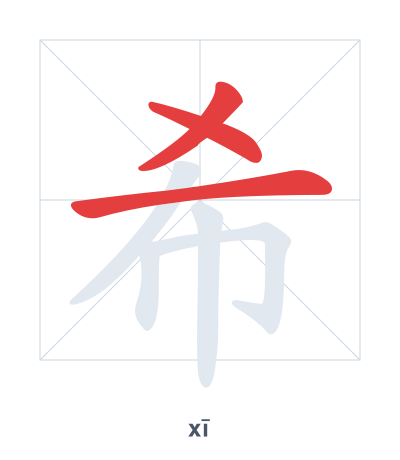
Open Hanzi Writer to see the animated stroke order and practice writing 希 with real-time feedback.
The character 希 (xī) is written with 7 strokes. Follow the standard Chinese stroke order: top to bottom, left to right, outside before inside. The radical 巾 is one of its key components.
Practice the correct stroke order with the Hanzi Writer app to see animated stroke-by-stroke guidance with real-time feedback.
希 means rare; hope.
As an HSK Level 3 character, 希 is an intermediate-level character.
希 originally combined 巾 (cloth) with 爻 (crossed threads), picturing a loom with a sparse weave—thus meaning 'rare'. Over time, it also came to mean 'hope', as in hoping for something rare.
💡 Memory Tip: Picture a cloth (巾) with just two crossed threads (乂), so rare that you hope to find more.
我希望明天不下雨。
wǒ xī wàng míng tiān bù xià yǔ
I hope it doesn't rain tomorrow.
他去年去了希腊。
tā qù nián qù le xī là
He went to Greece last year.
这没什么希罕的。
zhè méi shén me xī hǎn de
This is nothing unusual.
Open Hanzi Writer to see the animated stroke order and practice writing 希 with real-time feedback.
✨ Animated stroke order · Handwriting recognition · HSK-graded practice · Free to use
希 is composed of the radical 巾 (cloth) at the bottom and the phonetic component 乂 (now meaning "cross") on top. While 巾 hints at the original meaning of "fine cloth," the modern meaning of "rare" or "hope" does not directly come from the components. The structure helps you identify the character but not its current meanings.