怜 (lián) means "to pity; to love" in Chinese. It has 8 strokes with the radical 忄, and is HSK Level 5.
Rated 3.7/5 in difficulty (challenging).
Harder than 34% of HSK Level 5 characters.
Appears in 3+ common words including 可怜 (kě lián), 怜惜 (lián xī), 怜悯 (lián mǐn).
Due to its 8 strokes, Hanzi Writer's error detection shows 怜 requires focused practice — most learners need 10+ attempts for consistent accuracy.
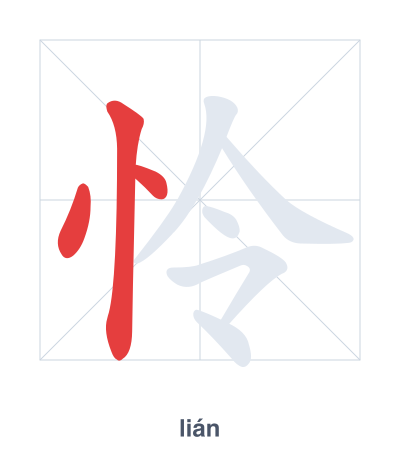
Open Hanzi Writer to see the animated stroke order and practice writing 怜 with real-time feedback.
The character 怜 (lián) is written with 8 strokes. Follow the standard Chinese stroke order: top to bottom, left to right, outside before inside. The radical 忄 is one of its key components.
Practice the correct stroke order with the Hanzi Writer app to see animated stroke-by-stroke guidance with real-time feedback.
怜 means to pity; to love.
As an HSK Level 5 character, 怜 is an intermediate-level character.
The character 怜 combines the heart radical 忄 (xīn), indicating emotion, with 令 (lìng, meaning 'order' or 'command'). Together, they suggest a heart moved to pity or tenderness by a command or situation, though the right component primarily provides phonetic cues.
💡 Memory Tip: Imagine a heart (忄) that hears a command (令) to feel pity, like ordering your heart to love someone in distress.
这只小猫真可怜。
zhè zhǐ xiǎo māo zhēn kě lián
This kitten is so pitiful.
他很怜惜这些花。
tā hěn lián xī zhè xiē huā
He cherishes these flowers.
我们要怜悯弱者。
wǒ men yào lián mǐn ruò zhě
We should pity the weak.
Open Hanzi Writer to see the animated stroke order and practice writing 怜 with real-time feedback.
✨ Animated stroke order · Handwriting recognition · HSK-graded practice · Free to use
怜 has the heart radical 忄 on the left, which connects to emotions like pity or love. The right side is 令 (lìng, meaning "order" or "cause"), suggesting that pity arises when something causes an emotional response from the heart.