悯 (mǐn) means "to pity; to sympathize" in Chinese. It has 10 strokes with the radical 忄.
Rated 4.2/5 in difficulty (advanced).
Appears in 3+ common words including 怜悯 (lián mǐn), 悲悯 (bēi mǐn), 悯农 (mǐn nóng).
Due to its 10 strokes, Hanzi Writer's error detection shows 悯 requires focused practice — most learners need 10+ attempts for consistent accuracy.
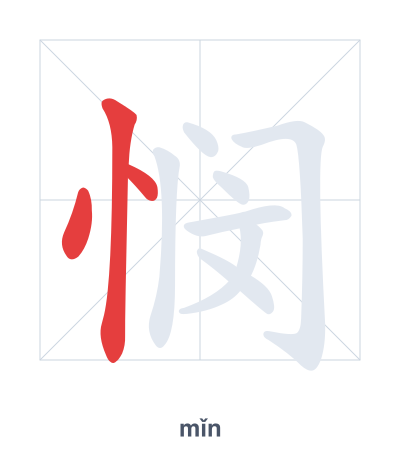
Open Hanzi Writer to see the animated stroke order and practice writing 悯 with real-time feedback.
The character 悯 (mǐn) is written with 10 strokes. Follow the standard Chinese stroke order: top to bottom, left to right, outside before inside. The radical 忄 is one of its key components.
Practice the correct stroke order with the Hanzi Writer app to see animated stroke-by-stroke guidance with real-time feedback.
悯 means to pity; to sympathize.
The character 悯 combines the heart radical 忄 with 闵 (mǐn), which originally depicted a gate (门) with a heart inside, suggesting sorrow felt within the home. Together, 悯 means 'to feel sympathy' from the heart, for someone else's grief or misfortune.
💡 Memory Tip: Picture a heart (忄) locked inside a gate (门) with tear-drop patterns (文) on the walls, making you feel pity for its sorrow.
他很有怜悯之心。
tā hěn yǒu lián mǐn zhī xīn
He has a very compassionate heart.
他的眼神充满悲悯。
tā de yǎn shén chōng mǎn bēi mǐn
His eyes are full of compassion.
我会背《悯农》这首诗。
wǒ huì bèi mǐn nóng zhè shǒu shī
I can recite the poem 'Sympathy for the Peasants'.
Open Hanzi Writer to see the animated stroke order and practice writing 悯 with real-time feedback.
✨ Animated stroke order · Handwriting recognition · HSK-graded practice · Free to use
悯 is made of the heart radical 忄 on the left and 闵 (mǐn) on the right. The heart radical shows the character relates to emotions, while 闵 provides the pronunciation and the core idea of pity or grief. Together, they create the meaning "to pity" or "to sympathize."