惜 (xī) means "to cherish; to pity" in Chinese. It has 11 strokes with the radical 忄, and is HSK Level 5.
Rated 4.2/5 in difficulty (advanced).
Harder than 67% of HSK Level 5 characters.
Appears in 3+ common words including 可惜 (kě xī), 珍惜 (zhēn xī), 爱惜 (ài xī).
Due to its 11 strokes, Hanzi Writer's error detection shows 惜 requires focused practice — most learners need 10+ attempts for consistent accuracy.
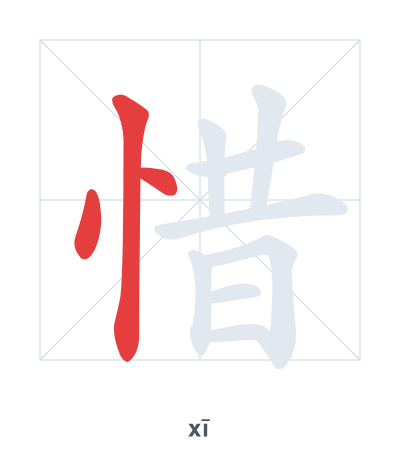
Open Hanzi Writer to see the animated stroke order and practice writing 惜 with real-time feedback.
The character 惜 (xī) is written with 11 strokes. Follow the standard Chinese stroke order: top to bottom, left to right, outside before inside. The radical 忄 is one of its key components.
Practice the correct stroke order with the Hanzi Writer app to see animated stroke-by-stroke guidance with real-time feedback.
惜 means to cherish; to pity.
As an HSK Level 5 character, 惜 is an intermediate-level character.
惜 combines the heart radical 忄 (emotion) with 昔 (past), suggesting a heartfelt connection to what has passed—either treasuring fond memories or feeling pity for losses.
💡 Memory Tip: Picture a heart (忄) wearing a time-traveling hat (昔) to remind you to cherish moments before they become past.
没去成真的很可惜。
méi qù chéng zhēn de hěn kě xī
It's a real pity that I couldn't go.
我们要珍惜时间。
wǒ men yào zhēn xī shí jiān
We should cherish time.
请爱惜公共财物。
qǐng ài xī gōng gòng cái wù
Please take care of public property.
Open Hanzi Writer to see the animated stroke order and practice writing 惜 with real-time feedback.
✨ Animated stroke order · Handwriting recognition · HSK-graded practice · Free to use
惜 is composed of the radical 忄 (heart, emotion) on the left and 昔 (xī, meaning "former times") on the right. The heart radical suggests a feeling toward the past, linking to cherishing memories or regret. Together, they convey the emotional sense of cherishing or pitying something from the past.