愧 (kuì) means "Ashamed; guilty." in Chinese. It has 12 strokes with the radical 忄, and is HSK Level 7.
Rated 4.2/5 in difficulty (advanced).
Harder than 56% of HSK Level 7 characters.
Appears in 3+ common words including 惭愧 (cán kuì), 愧疚 (kuì jiù), 羞愧 (xiū kuì).
Due to its 12 strokes, Hanzi Writer's error detection shows 愧 requires focused practice — most learners need 10+ attempts for consistent accuracy.
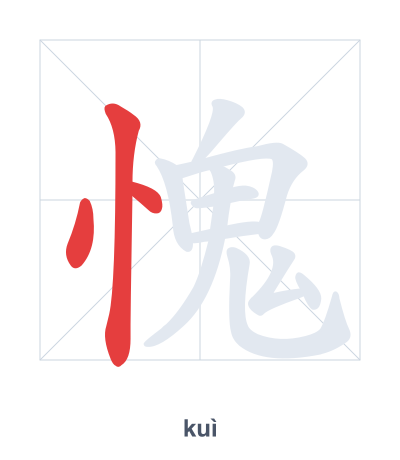
Open Hanzi Writer to see the animated stroke order and practice writing 愧 with real-time feedback.
The character 愧 (kuì) is written with 12 strokes. Follow the standard Chinese stroke order: top to bottom, left to right, outside before inside. The radical 忄 is one of its key components.
Practice the correct stroke order with the Hanzi Writer app to see animated stroke-by-stroke guidance with real-time feedback.
愧 means Ashamed; guilty..
As an HSK Level 7 character, 愧 is an intermediate-level character.
The character 愧 combines the radical 忄 (heart) with 鬼 (ghost). A heart tormented by a ghost suggests the haunting feeling of guilt or shame over one's actions.
💡 Memory Tip: Imagine a ghost (鬼) pointing a bony finger at your heart (忄), making you blush with shame.
我觉得很惭愧。
wǒ jué de hěn cán kuì
I feel very ashamed.
他心里充满愧疚。
tā xīn lǐ chōng mǎn kuì jiù
His heart was full of guilt.
她感到非常羞愧。
tā gǎn dào fēi cháng xiū kuì
She felt very ashamed.
Open Hanzi Writer to see the animated stroke order and practice writing 愧 with real-time feedback.
✨ Animated stroke order · Handwriting recognition · HSK-graded practice · Free to use
愧 has the radical 忄 (heart) on the left, which indicates emotions or feelings. The right part is 鬼 (guǐ, ghost or demon), which acts as a phonetic hint for the pronunciation kuì and also suggests the haunting feeling of shame. Together, the character literally means having a "heart haunted by ghosts," which creates a vivid image of guilt or shame.