悌 (tì) means "brotherly love" in Chinese. It has 10 strokes with the radical 忄.
Rated 4.2/5 in difficulty (advanced).
Appears in 3+ common words including 孝悌 (xiào tì), 悌友 (tì yǒu), 悌道 (tì dào).
Due to its 10 strokes, Hanzi Writer's error detection shows 悌 requires focused practice — most learners need 10+ attempts for consistent accuracy.
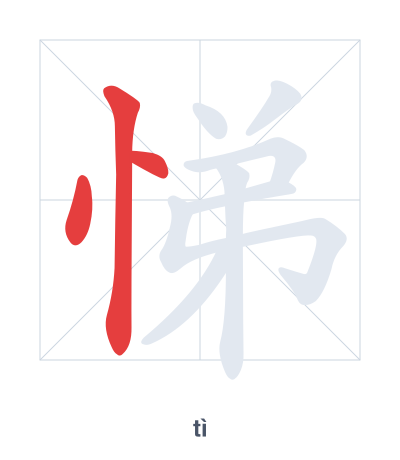
Open Hanzi Writer to see the animated stroke order and practice writing 悌 with real-time feedback.
The character 悌 (tì) is written with 10 strokes. Follow the standard Chinese stroke order: top to bottom, left to right, outside before inside. The radical 忄 is one of its key components.
Practice the correct stroke order with the Hanzi Writer app to see animated stroke-by-stroke guidance with real-time feedback.
悌 means brotherly love.
悌 combines the heart radical 忄 (xīn, emotion) with 弟 (dì, younger brother). It literally means 'heart for a younger brother', representing the affection and respect an older sibling should show.
💡 Memory Tip: Picture a heart (忄) gently bowing to a younger brother (弟), showing brotherly love.
孝悌是传统美德。
xiào tì shì chuán tǒng měi dé
Filial piety and fraternal love are traditional virtues.
兄弟之间要悌友。
xiōng dì zhī jiān yào tì yǒu
Brothers should be fraternal and friendly to each other.
他很遵守悌道。
tā hěn zūn shǒu tì dào
He strictly follows the way of brotherly respect.
Open Hanzi Writer to see the animated stroke order and practice writing 悌 with real-time feedback.
✨ Animated stroke order · Handwriting recognition · HSK-graded practice · Free to use
悌 combines the heart radical 忄 on the left with 弟 (younger brother) on the right. The heart radical indicates emotion, while 弟 provides the sound and the idea of brotherhood. Together, they mean "brotherly love" — the feeling of affection and respect among brothers.