惭 (cán) means "ashamed" in Chinese. It has 11 strokes with the radical 忄, and is HSK Level 7.
Rated 4.2/5 in difficulty (advanced).
Harder than 56% of HSK Level 7 characters.
Appears in 3+ common words including 惭愧 (cán kuì), 羞惭 (xiū cán), 惭色 (cán sè).
Due to its 11 strokes, Hanzi Writer's error detection shows 惭 requires focused practice — most learners need 10+ attempts for consistent accuracy.
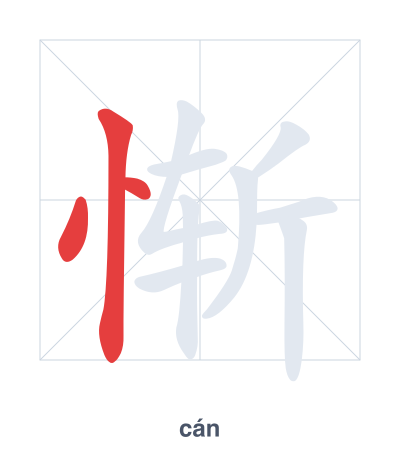
Open Hanzi Writer to see the animated stroke order and practice writing 惭 with real-time feedback.
The character 惭 (cán) is written with 11 strokes. Follow the standard Chinese stroke order: top to bottom, left to right, outside before inside. The radical 忄 is one of its key components.
Practice the correct stroke order with the Hanzi Writer app to see animated stroke-by-stroke guidance with real-time feedback.
惭 means ashamed.
As an HSK Level 7 character, 惭 is an intermediate-level character.
The character 惭 combines the heart radical 忄 (心) with 斩 (zhǎn, meaning 'to cut' or 'behead'). The compound suggests a feeling of shame, as if one's heart is being cut or severed by guilt or disgrace.
💡 Memory Tip: Imagine a guilty heart (忄) being sliced by a heavy axe (斤) on a cart (车), making you feel deeply ashamed.
我感到很惭愧。
wǒ gǎn dào hěn cán kuì
I feel very ashamed.
他心里感到羞惭。
tā xīn lǐ gǎn dào xiū cán
He feels ashamed.
他脸上露出惭色。
tā liǎn shàng lù chū cán sè
His face showed a look of shame.
Open Hanzi Writer to see the animated stroke order and practice writing 惭 with real-time feedback.
✨ Animated stroke order · Handwriting recognition · HSK-graded practice · Free to use
惭 has the heart radical 忄 on the left, which connects to emotions. The right part is 斩 (to chop), suggesting a feeling of being mentally 'cut' by shame. Together, the character represents the emotional pain of shame.