跨 (kuà) means "to stride" in Chinese. It has 13 strokes with the radical 足, and is HSK Level 6.
Rated 4.2/5 in difficulty (advanced).
Harder than 92% of HSK Level 6 characters.
Appears in 3+ common words including 跨步 (kuà bù), 跨越 (kuà yuè), 跨国 (kuà guó).
Due to its 13 strokes, Hanzi Writer's error detection shows 跨 requires focused practice — most learners need 10+ attempts for consistent accuracy.
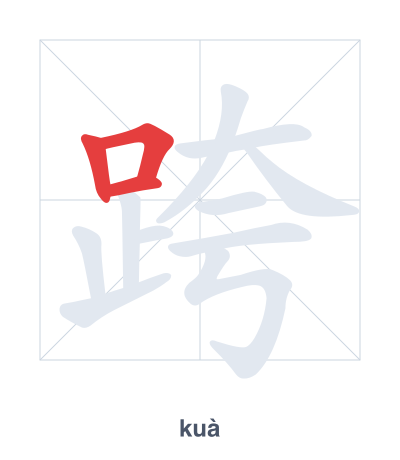
Open Hanzi Writer to see the animated stroke order and practice writing 跨 with real-time feedback.
The character 跨 (kuà) is written with 13 strokes. Follow the standard Chinese stroke order: top to bottom, left to right, outside before inside. The radical 足 is one of its key components.
Practice the correct stroke order with the Hanzi Writer app to see animated stroke-by-stroke guidance with real-time feedback.
跨 means to stride.
As an HSK Level 6 character, 跨 is an intermediate-level character.
跨 combines the radical 足 (foot) and the phonetic component 夸 (kuā, meaning 'to boast' or 'exaggerate'). The foot radical suggests an action involving the legs, while 夸 implies stretching or expanding, together forming the idea of taking a long, striding step.
💡 Memory Tip: Imagine a foot (足) taking a huge, boastful step (夸) across a wide gap.
他向前迈了一大跨步。
tā xiàng qián mài le yī dà kuà bù
He took a big stride forward.
我们要跨越困难。
wǒ men yào kuà yuè kùn nán
We need to overcome the difficulties.
这是一家跨国公司。
zhè shì yī jiā kuà guó gōng sī
This is a multinational company.
Open Hanzi Writer to see the animated stroke order and practice writing 跨 with real-time feedback.
✨ Animated stroke order · Handwriting recognition · HSK-graded practice · Free to use
The left side is 足 (zú), meaning "foot," which shows the character involves foot action. The right side is 夸 (kuā), which gives the sound and also hints at the idea of opening or stretching, as in taking a long stride.