嫉 (jí) means "To be jealous; to envy." in Chinese. It has 13 strokes with the radical 女, and is HSK Level 7.
Rated 4.2/5 in difficulty (advanced).
Harder than 52% of HSK Level 7 characters.
Appears in 3+ common words including 嫉妒 (jí dù), 嫉恨 (jí hèn), 嫉恶如仇 (jí è rú chóu).
Due to its 13 strokes, Hanzi Writer's error detection shows 嫉 requires focused practice — most learners need 10+ attempts for consistent accuracy.
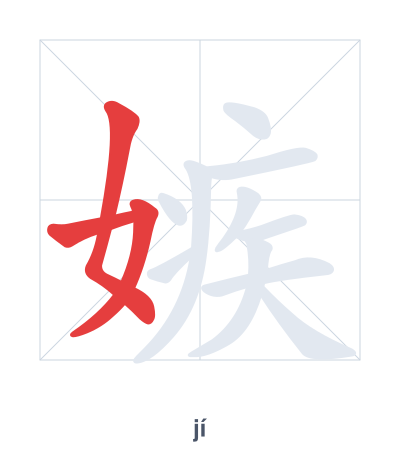
Open Hanzi Writer to see the animated stroke order and practice writing 嫉 with real-time feedback.
The character 嫉 (jí) is written with 13 strokes. Follow the standard Chinese stroke order: top to bottom, left to right, outside before inside. The radical 女 is one of its key components.
Practice the correct stroke order with the Hanzi Writer app to see animated stroke-by-stroke guidance with real-time feedback.
嫉 means To be jealous; to envy..
As an HSK Level 7 character, 嫉 is an intermediate-level character.
嫉 is a compound character combining the radical 女 (woman) with 疾 (jí, sickness/disease). The visual form suggests that jealousy is like a sickness, often associated with women in traditional contexts, though the meaning applies broadly.
💡 Memory Tip: Picture a woman (女) so consumed by envy that she literally catches the disease (疾) of jealousy, turning green with sickness.
不要嫉妒别人的成功。
bú yào jí dù bié rén de chéng gōng
Don't be jealous of others' success.
他心中充满了嫉恨。
tā xīn zhōng chōng mǎn le jí hèn
His heart was full of jealousy and hatred.
他是一个嫉恶如仇的人。
tā shì yí gè jí è rú chóu de rén
He is a person who hates evil as much as an enemy.
Open Hanzi Writer to see the animated stroke order and practice writing 嫉 with real-time feedback.
✨ Animated stroke order · Handwriting recognition · HSK-graded practice · Free to use
The character 嫉 combines the radical 女 (woman) on the left and the phonetic component 疾 (jí, meaning illness or speed) on the right. The radical 女 suggests that jealousy is often associated with women in traditional contexts, but the character actually applies to anyone. The right side 疾 gives the sound and also hints at the intense, painful feeling of envy, like a sickness.