患 (huàn) means "suffer" in Chinese. It has 11 strokes with the radical 心, and is HSK Level 6.
Rated 4.2/5 in difficulty (advanced).
Harder than 60% of HSK Level 6 characters.
Appears in 3+ common words including 患者 (huàn zhě), 患病 (huàn bìng), 忧患 (yōu huàn).
Due to its 11 strokes, Hanzi Writer's error detection shows 患 requires focused practice — most learners need 10+ attempts for consistent accuracy.
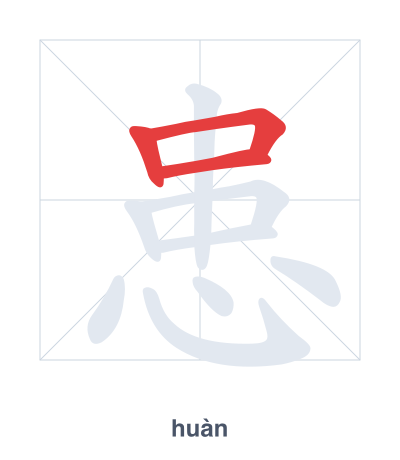
Open Hanzi Writer to see the animated stroke order and practice writing 患 with real-time feedback.
The character 患 (huàn) is written with 11 strokes. Follow the standard Chinese stroke order: top to bottom, left to right, outside before inside. The radical 心 is one of its key components.
Practice the correct stroke order with the Hanzi Writer app to see animated stroke-by-stroke guidance with real-time feedback.
患 means suffer.
As an HSK Level 6 character, 患 is an intermediate-level character.
The character 患 combines 串 (a string of coins or troubles) above 心 (heart), literally depicting worries or afflictions stringing together around the heart, causing suffering.
💡 Memory Tip: Imagine a string of spiky problems (串) piercing your heart (心) — that's real suffering.
医生在看患者。
yī shēng zài kàn huàn zhě
The doctor is seeing a patient.
他不幸患病了。
tā bù xìng huàn bìng le
He unfortunately fell ill.
我们要有忧患意识。
wǒ men yào yǒu yōu huàn yì shí
We should have a sense of crisis.
Open Hanzi Writer to see the animated stroke order and practice writing 患 with real-time feedback.
✨ Animated stroke order · Handwriting recognition · HSK-graded practice · Free to use
The character 患 is composed of 串 (a string of items) on top and 心 (heart) below. This structure suggests a string of worries or troubles hanging on the heart, which leads to the meaning of suffering or hardship.