者 (zhě) means "Person who... / -er / -ist" in Chinese. It has 8 strokes with the radical 耂, and is HSK Level 2.
Rated 3.2/5 in difficulty (challenging).
Harder than 54% of HSK Level 2 characters.
Appears in 3+ common words including 或者 (huò zhě), 作者 (zuò zhě), 记者 (jì zhě).
Due to its 8 strokes, Hanzi Writer's error detection shows 者 requires focused practice — most learners need 10+ attempts for consistent accuracy.
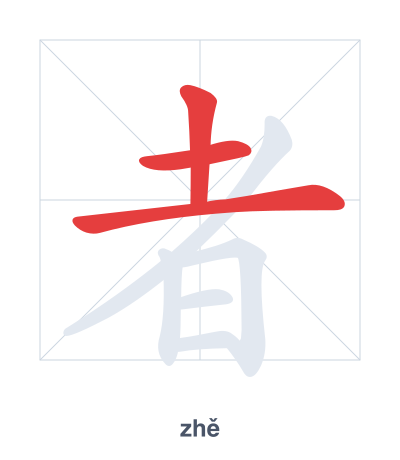
Open Hanzi Writer to see the animated stroke order and practice writing 者 with real-time feedback.
The character 者 (zhě) is written with 8 strokes. Follow the standard Chinese stroke order: top to bottom, left to right, outside before inside. The radical 耂 is one of its key components.
Practice the correct stroke order with the Hanzi Writer app to see animated stroke-by-stroke guidance with real-time feedback.
者 means Person who... / -er / -ist.
As an HSK Level 2 character, 者 is among the first characters beginners learn.
Originally, 者 depicted a person (人) with a mouth (曰) open to speak, meaning 'the one who speaks.' Over time, the person figure evolved into the top component 耂 (resembling an old person), but the core idea of 'a person who does something' remains.
💡 Memory Tip: Picture an old person (耂) with a big square mouth (曰) — that's the 'one who' never stops talking.
你去或者我去?
nǐ qù huò zhě wǒ qù
Are you going, or should I?
我喜欢这个作者。
wǒ xǐ huān zhè ge zuò zhě
I like this author.
记者在写新闻。
jì zhě zài xiě xīn wén
The reporter is writing a news story.
Open Hanzi Writer to see the animated stroke order and practice writing 者 with real-time feedback.
✨ Animated stroke order · Handwriting recognition · HSK-graded practice · Free to use
者 is composed of the radical 耂 (old) on top and 日 (sun) below. However, its meaning as a suffix meaning "person who" does not directly come from these parts; it is a conventional use. The structure is best remembered as a visual combination rather than a literal representation of its meaning.