怒 (nù) means "anger; rage; angry" in Chinese. It has 9 strokes with the radical 心, and is HSK Level 6.
Rated 4/5 in difficulty (challenging).
Harder than 46% of HSK Level 6 characters.
Appears in 3+ common words including 发怒 (fā nù), 愤怒 (fèn nù), 怒气 (nù qì).
Due to its 9 strokes, Hanzi Writer's error detection shows 怒 requires focused practice — most learners need 10+ attempts for consistent accuracy.
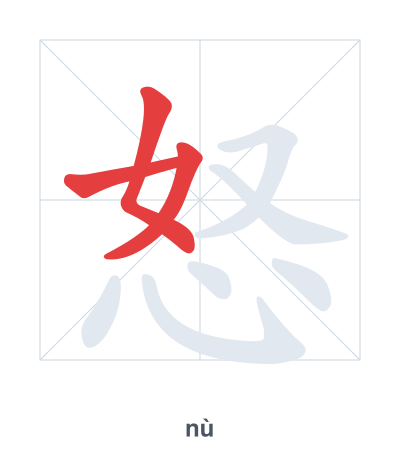
Open Hanzi Writer to see the animated stroke order and practice writing 怒 with real-time feedback.
The character 怒 (nù) is written with 9 strokes. Follow the standard Chinese stroke order: top to bottom, left to right, outside before inside. The radical 心 is one of its key components.
Practice the correct stroke order with the Hanzi Writer app to see animated stroke-by-stroke guidance with real-time feedback.
怒 means anger; rage; angry.
As an HSK Level 6 character, 怒 is an intermediate-level character.
怒 is a compound character combining 奴 (nú, meaning 'slave') and 心 (xīn, meaning 'heart'). The heart radical suggests an emotion, while 奴 conveys the idea of oppression or subjugation, together indicating the feeling of anger that arises from being treated like a slave or from a constrained situation.
💡 Memory Tip: Imagine a slave (奴) whose heart (心) is boiling over with fury, like a volcano erupting in rage.
他很少发怒。
tā hěn shǎo fā nù
He rarely gets angry.
他的行为让人愤怒。
tā de xíng wéi ràng rén fèn nù
His behavior makes people angry.
他消了怒气。
tā xiāo le nù qì
His anger subsided.
Open Hanzi Writer to see the animated stroke order and practice writing 怒 with real-time feedback.
✨ Animated stroke order · Handwriting recognition · HSK-graded practice · Free to use
怒 is composed of two parts: 奴 (nú, meaning 'slave') on top and 心 (xīn, meaning 'heart') on the bottom. The idea is that anger is a powerful emotion that arises from the heart when one feels oppressed or enslaved. This combination visually suggests 'a slave's heart' filled with pent-up rage.