唬 (hǔ) means "To intimidate / To bluff" in Chinese. It has 11 strokes with the radical 口, and is HSK Level 7.
Rated 4.2/5 in difficulty (advanced).
Harder than 48% of HSK Level 7 characters.
Appears in 3+ common words including 吓唬 (xià hǔ), 唬人 (hǔ rén), 唬了一跳 (hǔ le yī tiào).
Due to its 11 strokes, Hanzi Writer's error detection shows 唬 requires focused practice — most learners need 10+ attempts for consistent accuracy.
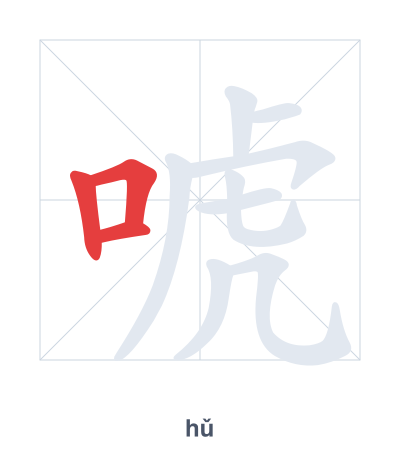
Open Hanzi Writer to see the animated stroke order and practice writing 唬 with real-time feedback.
The character 唬 (hǔ) is written with 11 strokes. Follow the standard Chinese stroke order: top to bottom, left to right, outside before inside. The radical 口 is one of its key components.
Practice the correct stroke order with the Hanzi Writer app to see animated stroke-by-stroke guidance with real-time feedback.
唬 means To intimidate / To bluff.
As an HSK Level 7 character, 唬 is an intermediate-level character.
唬 combines the radical 口 (mouth) with 虎 (tiger) to suggest the roar of a tiger used to scare others. The character literally means 'to make a tiger's sound with the mouth' — a bluff or intimidation through words.
💡 Memory Tip: Imagine a person opening their mouth wide (口) to imitate a fierce tiger's (虎) roar, bluffing to frighten someone away.
别吓唬小孩子。
bié xià hǔ xiǎo hái zi
Don't scare the children.
这话是唬人的。
zhè huà shì hǔ rén de
These words are just a bluff.
真是唬了我一跳。
zhēn shì hǔ le wǒ yī tiào
You really gave me a fright.
Open Hanzi Writer to see the animated stroke order and practice writing 唬 with real-time feedback.
✨ Animated stroke order · Handwriting recognition · HSK-graded practice · Free to use
唬 is built from the radical 口 (mouth) on the left, and the character 虎 (tiger) on the right. The mouth suggests speech or sound, and the tiger represents ferocity, so together they create the idea of using words to intimidate or bluff like a tiger's roar.