滚 (gǔn) means "to roll; to boil; to get lost" in Chinese. It has 13 strokes with the radical 氵, and is HSK Level 5.
Rated 4.2/5 in difficulty (advanced).
Harder than 78% of HSK Level 5 characters.
Appears in 3+ common words including 翻滚 (fān gǔn), 滚烫 (gǔn tàng), 滚蛋 (gǔn dàn).
Due to its 13 strokes, Hanzi Writer's error detection shows 滚 requires focused practice — most learners need 10+ attempts for consistent accuracy.
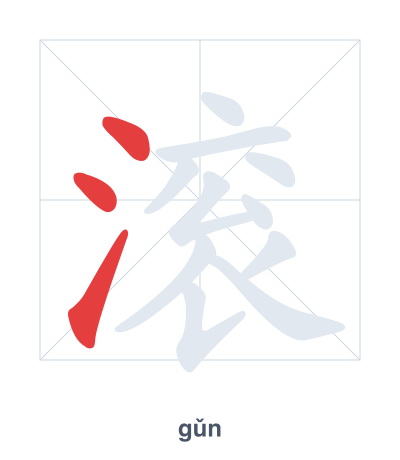
Open Hanzi Writer to see the animated stroke order and practice writing 滚 with real-time feedback.
The character 滚 (gǔn) is written with 13 strokes. Follow the standard Chinese stroke order: top to bottom, left to right, outside before inside. The radical 氵 is one of its key components.
Practice the correct stroke order with the Hanzi Writer app to see animated stroke-by-stroke guidance with real-time feedback.
滚 means to roll; to boil; to get lost.
As an HSK Level 5 character, 滚 is an intermediate-level character.
滚 combines the water radical 氵 with the phonetic component 衮 (an ancient imperial robe). The water element evokes boiling water that bubbles and rolls, or the tumbling motion of water currents, which extended to mean 'to roll' and colloquially 'to get lost.'
💡 Memory Tip: Picture a boiling pot of water (氵) bubbling over an ornate robe (衮), causing it to roll away as you shout, '滚—get lost!'
他不小心从台阶上翻滚下来。
tā bù xiǎo xīn cóng tái jiē shàng fān gǔn xià lái 。
He accidentally tumbled down the stairs.
火很旺,锅里水烧的滚烫。
huǒ hěn wàng , guō lǐ shuǐ shāo de gǔn tàng 。
The fire is strong, and the water in the pot is boiling hot.
别在这里捣乱,快滚蛋!
bié zài zhè lǐ dǎo luàn , kuài gǔn dàn !
Don't make trouble here, get lost!
Open Hanzi Writer to see the animated stroke order and practice writing 滚 with real-time feedback.
✨ Animated stroke order · Handwriting recognition · HSK-graded practice · Free to use
滚 is made of the water radical 氵 on the left and the component 衮 on the right. The water radical hints at the meanings "to roll" (like rolling water) and "to boil" (bubbling water), while 衮 provides pronunciation. Together they create a character that describes water moving or being heated.