烫 (tàng) means "Scalding or to scald" in Chinese. It has 10 strokes with the radical 火, and is HSK Level 7.
Rated 4.2/5 in difficulty (advanced).
Harder than 70% of HSK Level 7 characters.
Appears in 3+ common words including 烫手 (tàng shǒu), 烫发 (tàng fà), 滚烫 (gǔn tàng).
Due to its 10 strokes, Hanzi Writer's error detection shows 烫 requires focused practice — most learners need 10+ attempts for consistent accuracy.
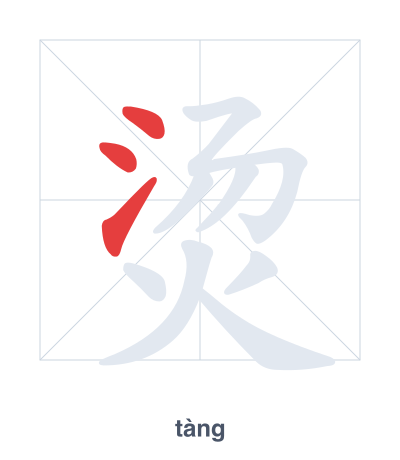
Open Hanzi Writer to see the animated stroke order and practice writing 烫 with real-time feedback.
The character 烫 (tàng) is written with 10 strokes. Follow the standard Chinese stroke order: top to bottom, left to right, outside before inside. The radical 火 is one of its key components.
Practice the correct stroke order with the Hanzi Writer app to see animated stroke-by-stroke guidance with real-time feedback.
烫 means Scalding or to scald.
As an HSK Level 7 character, 烫 is an intermediate-level character.
烫 combines the radical 火 (fire) with 汤 (tāng, 'soup' or 'hot water'), indicating scalding caused by fire-heated liquid. The left side 火 shows flames, and the right side 汤 hints at boiling soup. Originally, it depicted burning or scalding from hot water or fire.
💡 Memory Tip: Imagine dropping a spoon into a pot of boiling soup (汤) and splashing your hand with fiery (火) hot liquid—ouch, that's 烫 (scalding)!
这碗汤很烫手。
zhè wǎn tāng hěn tàng shǒu
This bowl of soup is very hot to the touch.
她去理发店烫发。
tā qù lǐ fà diàn tàng fà
She went to the hair salon to get a perm.
水是滚烫的。
shuǐ shì gǔn tàng de
The water is boiling hot.
Open Hanzi Writer to see the animated stroke order and practice writing 烫 with real-time feedback.
✨ Animated stroke order · Handwriting recognition · HSK-graded practice · Free to use
烫 combines the radical 火 (fire, on top) with a phonetic component 汤 (tāng, soup) that hints at pronunciation. The fire radical directly connects to the meaning of heat or scalding, while 汤 suggests hot liquid. Together, they form the idea of something so hot it burns, like boiling water or a heated surface.