鬼 (guǐ) means "Ghost" in Chinese. It has 9 strokes with the radical 鬼, and is HSK Level 5.
Rated 3.3/5 in difficulty (challenging).
Harder than 18% of HSK Level 5 characters.
Appears in 3+ common words including 鬼脸 (guǐ liǎn), 胆小鬼 (dǎn xiǎo guǐ), 酒鬼 (jiǔ guǐ).
Due to its 9 strokes, Hanzi Writer's error detection shows 鬼 requires focused practice — most learners need 10+ attempts for consistent accuracy.
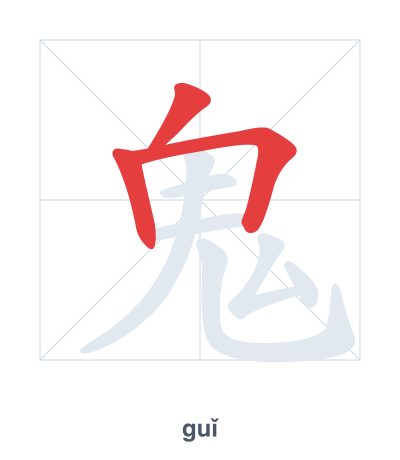
Open Hanzi Writer to see the animated stroke order and practice writing 鬼 with real-time feedback.
The character 鬼 (guǐ) is written with 9 strokes. Follow the standard Chinese stroke order: top to bottom, left to right, outside before inside. The radical 鬼 is one of its key components.
Practice the correct stroke order with the Hanzi Writer app to see animated stroke-by-stroke guidance with real-time feedback.
鬼 means Ghost.
As an HSK Level 5 character, 鬼 is an intermediate-level character.
The character 鬼 originally depicted a ghostly figure with a large, masked head and a trailing body. In oracle bone script, it shows a person wearing a fearsome mask, representing a supernatural spirit. The modern form retains the top part resembling a strange head and the bottom suggesting legs or a tail.
💡 Memory Tip: Picture a ghost with a white face (the top part 白) and two wiggly legs (the bottom 儿) sneaking around at midnight.
弟弟对我做鬼脸。
dì di duì wǒ zuò guǐ liǎn
Little brother made a face at me.
我不是个胆小鬼。
wǒ bú shì gè dǎn xiǎo guǐ
I'm not a coward.
他是个有名的酒鬼。
tā shì gè yǒu míng de jiǔ guǐ
He is a famous drunkard.
Open Hanzi Writer to see the animated stroke order and practice writing 鬼 with real-time feedback.
✨ Animated stroke order · Handwriting recognition · HSK-graded practice · Free to use
The character 鬼 is a pictograph of a ghost with a large head and a wavy body or tail. The radical 鬼 itself represents a supernatural being, and the strokes suggest a head, arms, and legs.