魁 (kuí) means "Chief" in Chinese. It has 13 strokes with the radical 鬼, and is HSK Level 7.
Rated 4.2/5 in difficulty (advanced).
Harder than 99% of HSK Level 7 characters.
Appears in 3+ common words including 魁梧 (kuí wú), 夺魁 (duó kuí), 魁首 (kuí shǒu).
Due to its 13 strokes, Hanzi Writer's error detection shows 魁 requires focused practice — most learners need 10+ attempts for consistent accuracy.
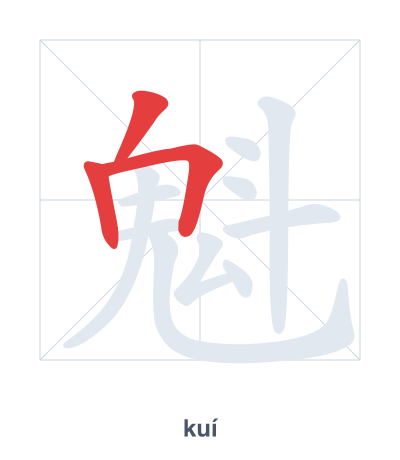
Open Hanzi Writer to see the animated stroke order and practice writing 魁 with real-time feedback.
The character 魁 (kuí) is written with 13 strokes. Follow the standard Chinese stroke order: top to bottom, left to right, outside before inside. The radical 鬼 is one of its key components.
Practice the correct stroke order with the Hanzi Writer app to see animated stroke-by-stroke guidance with real-time feedback.
魁 means Chief.
As an HSK Level 7 character, 魁 is an intermediate-level character.
魁 combines the radical 鬼 (ghost/spirit) with 斗 (dipper, a measuring tool). In ancient Chinese astronomy, the Big Dipper (北斗) was seen as the chief among stars, and the ghost radical adds a sense of spiritual authority, so 魁 came to mean 'chief' or 'leader'.
💡 Memory Tip: Picture a ghost (鬼) clutching a giant dipper (斗) like a scepter, crowning itself the chief of the spirit world.
那个运动员很魁梧。
nà ge yùn dòng yuán hěn kuí wú
That athlete is very well-built.
他在比赛中夺魁。
tā zài bǐ sài zhōng duó kuí
He won the championship in the competition.
他是班里的魁首。
tā shì bān lǐ de kuí shǒu
He is the head of the class.
Open Hanzi Writer to see the animated stroke order and practice writing 魁 with real-time feedback.
✨ Animated stroke order · Handwriting recognition · HSK-graded practice · Free to use
魁 is composed of 鬼 (ghost) on the left and 斗 (dipper) on the right. The 鬼 radical gives it a supernatural or powerful feeling, while 斗 originally meant a large ladle, hinting at something big or chief. Together they create the meaning "chief" or "leader."