魂 (hún) means "Soul" in Chinese. It has 13 strokes with the radical 鬼, and is HSK Level 7.
Rated 4.2/5 in difficulty (advanced).
Harder than 99% of HSK Level 7 characters.
Appears in 3+ common words including 灵魂 (líng hún), 魂魄 (hún pò), 丢魂 (diū hún).
Due to its 13 strokes, Hanzi Writer's error detection shows 魂 requires focused practice — most learners need 10+ attempts for consistent accuracy.
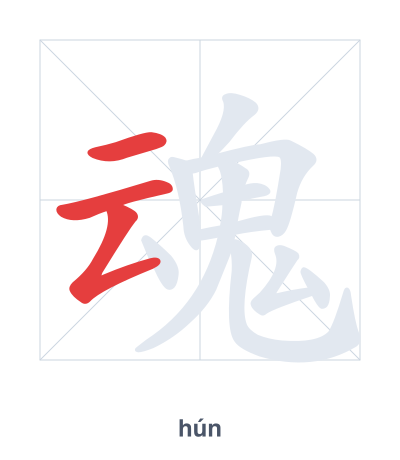
Open Hanzi Writer to see the animated stroke order and practice writing 魂 with real-time feedback.
The character 魂 (hún) is written with 13 strokes. Follow the standard Chinese stroke order: top to bottom, left to right, outside before inside. The radical 鬼 is one of its key components.
Practice the correct stroke order with the Hanzi Writer app to see animated stroke-by-stroke guidance with real-time feedback.
魂 means Soul.
As an HSK Level 7 character, 魂 is an intermediate-level character.
魂 combines 鬼 (ghost/spirit) with 云 (cloud), which also provides pronunciation. In ancient Chinese belief, the soul (魂) was considered a cloud-like spirit that could leave the body, especially after death.
💡 Memory Tip: Picture a ghost (鬼) rising as a cloudy vapor (云) into the sky—that's the soul escaping.
眼睛是灵魂的窗户。
yǎn jīng shì líng hún de chuāng hù
The eyes are the windows to the soul.
他的魂魄飞走了。
tā de hún pò fēi zǒu le
His soul has departed.
他看起来丢魂了。
tā kàn qǐ lái diū hún le
He looks like he's lost his soul.
Open Hanzi Writer to see the animated stroke order and practice writing 魂 with real-time feedback.
✨ Animated stroke order · Handwriting recognition · HSK-graded practice · Free to use
魂 is composed of two parts: the left side 云 (yún, cloud) and the right side 鬼 (guǐ, ghost or spirit). The character uses the ghost radical to indicate something spiritual, while 云 provides a phonetic clue for pronunciation (hún). Together, they represent the soul as a spirit that can drift like a cloud.