魅 (mèi) means "Charm" in Chinese. It has 14 strokes with the radical 鬼, and is HSK Level 7.
Rated 4.2/5 in difficulty (advanced).
Harder than 99% of HSK Level 7 characters.
Appears in 3+ common words including 魅力 (mèi lì), 魅惑 (mèi huò), 魑魅 (chī mèi).
Due to its 14 strokes, Hanzi Writer's error detection shows 魅 requires focused practice — most learners need 10+ attempts for consistent accuracy.
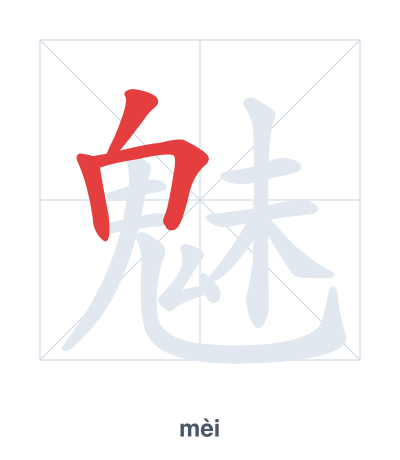
Open Hanzi Writer to see the animated stroke order and practice writing 魅 with real-time feedback.
The character 魅 (mèi) is written with 14 strokes. Follow the standard Chinese stroke order: top to bottom, left to right, outside before inside. The radical 鬼 is one of its key components.
Practice the correct stroke order with the Hanzi Writer app to see animated stroke-by-stroke guidance with real-time feedback.
魅 means Charm.
As an HSK Level 7 character, 魅 is an intermediate-level character.
魅 is a phono-semantic compound: the radical 鬼 (ghost/demon) indicates a supernatural being, while 未 (mèi) provides the pronunciation. Originally it referred to a seductive demon that lures people, later extending to mean charm or allure.
💡 Memory Tip: Picture a ghost (鬼) wearing a stylish hat shaped like the top of 未 (wèi), charming everyone with its irresistible allure.
他的笑容很有魅力。
tā de xiào róng hěn yǒu mèi lì
His smile is very charming.
这种颜色很魅惑。
zhè zhǒng yán sè hěn mèi huò
This color is very alluring.
森林里有魑魅。
sēn lín lǐ yǒu chī mèi
There are mountain demons in the forest.
Open Hanzi Writer to see the animated stroke order and practice writing 魅 with real-time feedback.
✨ Animated stroke order · Handwriting recognition · HSK-graded practice · Free to use
魅 is composed of the radical 鬼 (ghost) on the left and the component 未 (wèi) on the right. The radical 鬼 connects the character to supernatural or demonic beings, while 未 originally hinted at pronunciation. Together, they suggest a ghostly or magical charm that can bewitch people.