魈 (xiāo) means "Mountain demon" in Chinese. It has 16 strokes with the radical 鬼.
Rated 4.2/5 in difficulty (advanced).
Appears in 3+ common words including 山魈 (shān xiāo), 魈魅 (xiāo mèi), 魈鬼 (xiāo guǐ).
Due to its 16 strokes, Hanzi Writer's error detection shows 魈 requires focused practice — most learners need 10+ attempts for consistent accuracy.
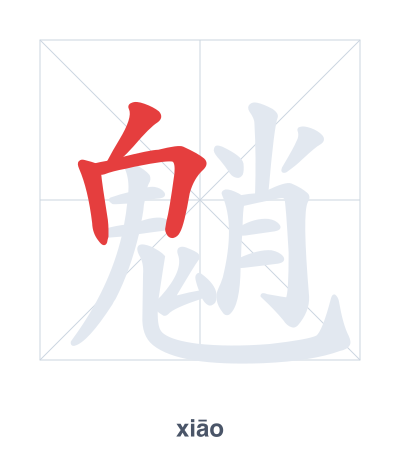
Open Hanzi Writer to see the animated stroke order and practice writing 魈 with real-time feedback.
The character 魈 (xiāo) is written with 16 strokes. Follow the standard Chinese stroke order: top to bottom, left to right, outside before inside. The radical 鬼 is one of its key components.
Practice the correct stroke order with the Hanzi Writer app to see animated stroke-by-stroke guidance with real-time feedback.
魈 means Mountain demon.
| Character | 魈 |
| Pinyin | xiāo (xiao) |
| Meaning | Mountain demon |
| Strokes | 16 |
| Radical | 鬼 |
| Difficulty | 4.2/5 |
This character is a compound of the radical 鬼 (guǐ, 'ghost/spirit') and the phonetic component 肖 (xiāo, meaning 'resemble'). In Chinese folklore, 魈 refers to a solitary mountain demon often depicted as a one-legged goblin. The combination visually suggests a ghostly entity (鬼) that has a resemblance (肖) to something, emphasizing its supernatural yet familiar form.
💡 Memory Tip: Imagine a ghost (鬼) with a monkey-like face (肖) leaping through mountain forests—that mischievous, grinning demon is 魈.
我们在看山魈。
wǒ men zài kàn shān xiāo
We are looking at the mandrill.
传说山中有魈魅。
chuán shuō shān zhōng yǒu xiāo mèi
Legend says there are mountain demons.
故事里提到了魈鬼。
gù shì lǐ tí dào le xiāo guǐ
The story mentioned mountain demons.
Open Hanzi Writer to see the animated stroke order and practice writing 魈 with real-time feedback.
✨ Animated stroke order · Handwriting recognition · HSK-graded practice · Free to use
魈 is formed from the radical 鬼 (ghost) on the left, which signals the character relates to spirits or demons, and the component 肖 (xiāo) on the right, which gives the sound and also hints at something small or resembling. Together, 魈 literally means "mountain demon" — a small, ghost-like creature living in the mountains.