遏 (è) means "To stop / To check" in Chinese. It has 12 strokes with the radical 辶, and is HSK Level 7.
Rated 4.2/5 in difficulty (advanced).
Harder than 93% of HSK Level 7 characters.
Appears in 3+ common words including 遏止 (è zhǐ), 遏制 (è zhì), 怒不可遏 (nù bù kě è).
Due to its 12 strokes, Hanzi Writer's error detection shows 遏 requires focused practice — most learners need 10+ attempts for consistent accuracy.
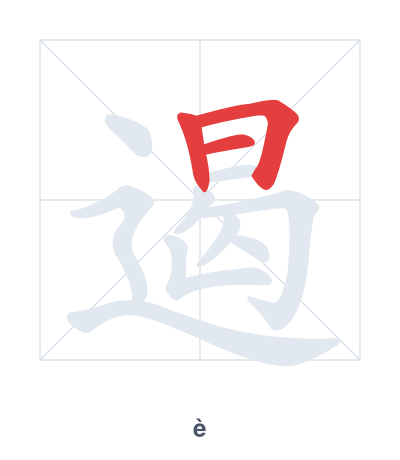
Open Hanzi Writer to see the animated stroke order and practice writing 遏 with real-time feedback.
The character 遏 (è) is written with 12 strokes. Follow the standard Chinese stroke order: top to bottom, left to right, outside before inside. The radical 辶 is one of its key components.
Practice the correct stroke order with the Hanzi Writer app to see animated stroke-by-stroke guidance with real-time feedback.
遏 means To stop / To check.
As an HSK Level 7 character, 遏 is an intermediate-level character.
遏 is a phono-semantic compound: the radical 辶 (walking) indicates movement being stopped, while 曷 (è, a phonetic component) originally depicted a person shouting to halt, combining to mean 'to check or obstruct'.
💡 Memory Tip: Imagine a person walking (辶) who is suddenly stopped by a loud 'HEY!' (曷 sounds like 'hey') — that shout 'checks' their movement.
必须遏止这种行为。
bì xū è zhǐ zhè zhǒng xíng wéi
This behavior must be stopped.
遏制通货膨胀。
è zhì tōng huò péng zhàng
To curb inflation.
他气得怒不可遏。
tā qì dé nù bù kě è
He was so angry that he couldn't contain his rage.
Open Hanzi Writer to see the animated stroke order and practice writing 遏 with real-time feedback.
✨ Animated stroke order · Handwriting recognition · HSK-graded practice · Free to use
遏 consists of the radical 辶 (walk) and the phonetic component 曷 (hé). The radical 辶 suggests movement or action, while the whole character means "to stop" or "to block" that movement. Together, they create the idea of halting motion.