止 (zhǐ) means "Stop" in Chinese. It has 4 strokes with the radical 止, and is HSK Level 3.
Rated 2.4/5 in difficulty (moderate).
Harder than 9% of HSK Level 3 characters.
Appears in 3+ common words including 停止 (tíng zhǐ), 禁止 (jìn zhǐ), 止痛 (zhǐ tòng).
Hanzi Writer's stroke validation shows learners typically need 5-8 attempts to write 止 with correct proportion and order.
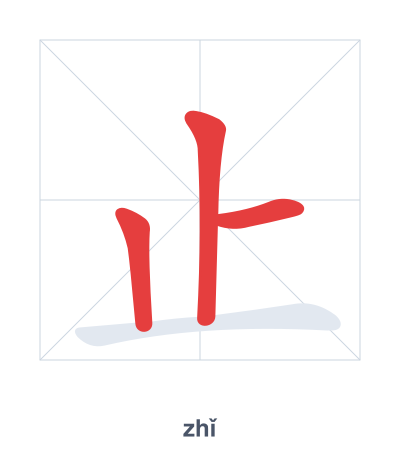
Open Hanzi Writer to see the animated stroke order and practice writing 止 with real-time feedback.
The character 止 (zhǐ) is written with 4 strokes. Follow the standard Chinese stroke order: top to bottom, left to right, outside before inside. The radical 止 is one of its key components.
Practice the correct stroke order with the Hanzi Writer app to see animated stroke-by-stroke guidance with real-time feedback.
止 means Stop.
As an HSK Level 3 character, 止 is an intermediate-level character.
The ancient form of 止 was a pictograph of a foot with toes pointing upward, symbolizing a foot coming to a halt. This image of a stationary foot directly conveys the meaning 'to stop.' Over time, the shape simplified to the four-stroke character seen today.
💡 Memory Tip: Picture a foot with four toes (the four strokes) stamping down to say 'stop!'
请停止说话。
qǐng tíng zhǐ shuō huà
Please stop talking.
这里禁止停车。
zhè lǐ jìn zhǐ tíng chē
No parking here.
这种药可以止痛。
zhè zhǒng yào kě yǐ zhǐ tòng
This medicine can relieve pain.
Open Hanzi Writer to see the animated stroke order and practice writing 止 with real-time feedback.
✨ Animated stroke order · Handwriting recognition · HSK-graded practice · Free to use
The character 止 is both a radical and a standalone character. Its ancient form depicted a footprint or a foot stopping, which visually links to the meaning of "stop" or "cease."