Hanzi Writer

How to Write 蹲 (dūn) — Meaning “to squat; to stay (somewhere)”

dūn HSK Level 6 19 strokes Radical: 足

蹲 (dūn) means "to squat; to stay (somewhere)" in Chinese. It has 19 strokes with the radical 足, and is HSK Level 6.

Rated 4.2/5 in difficulty (advanced).

Harder than 94% of HSK Level 6 characters.

Appears in 3+ common words including 蹲下 (dūn xià), 蹲着 (dūn zhe), 蹲坑 (dūn kēng).

Due to its 19 strokes, Hanzi Writer's error detection shows 蹲 requires focused practice — most learners need 10+ attempts for consistent accuracy.
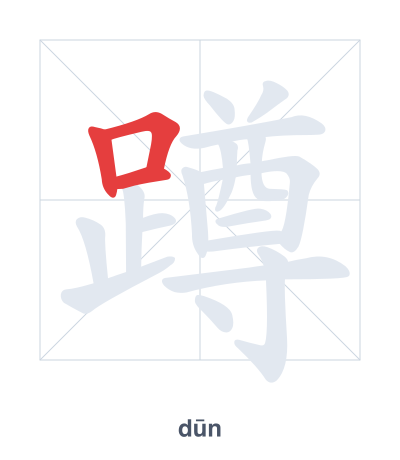
Stroke order practice for 蹲 - dūn

Practice Writing 蹲 (dūn)

Open Hanzi Writer to see the animated stroke order and practice writing 蹲 with real-time feedback.

The character (dūn) is written with 19 strokes. Follow the standard Chinese stroke order: top to bottom, left to right, outside before inside. The radical is one of its key components.

Practice the correct stroke order with the Hanzi Writer app to see animated stroke-by-stroke guidance with real-time feedback.

means to squat; to stay (somewhere).

As an HSK Level 6 character, is an intermediate-level character.

Character
Pinyindūn (dun)
Meaningto squat; to stay (somewhere)
Strokes19
Radical
HSK Level6
Difficulty4.2/5

蹲 is a phono-semantic compound. The radical 足 (foot) indicates the action involves the legs or feet, while 尊 (zūn, meaning 'honor') contributes the pronunciation. The act of squatting can be seen as a respectful posture, linking the meaning to the idea of deference implied by 尊.

💡 Memory Tip: Picture a person squatting respectfully to offer a bottle of wine (尊) with their feet (足) planted on the ground.

dūn xià
to squat down
dūn zhe
squatting
dūn kēng
to use a pit toilet; to squat over a hole

请你蹲下看这朵花。

qǐng nǐ dūn xià kàn zhè duǒ huā

Please squat down and look at this flower.

他正蹲着在草丛里寻找那只失踪的蛐蛐。

tā zhèng dūn zhe zài cǎo cóng lǐ xún zhǎo nà zhǐ shī zōng de qū qū 。

He is crouching in the grass looking for the missing cricket.

这里的厕所是蹲坑。

zhè lǐ de cè suǒ shì dūn kēng

The toilets here are squat toilets.

Character Pinyin Strokes Radical
(current) dūn 19
jiǎn 17
dǎo 17
qī / xī 17
Stroke order practice for 蹲 - dūn

Practice Writing 蹲 (dūn)

Open Hanzi Writer to see the animated stroke order and practice writing 蹲 with real-time feedback.

✨ Animated stroke order · Handwriting recognition · HSK-graded practice · Free to use

Frequently Asked Questions about 蹲

The left side is the radical 足, meaning 'foot' or 'leg,' which connects to the action of squatting. The right side is 尊, which provides a rough phonetic clue (though pronounced zūn, not dūn). Together, the character suggests a foot-related action associated with the sound component.

More HSK Level 6 Characters

Characters with Radical 足

Other 19-Stroke Characters