攒 (cuán/zǎn) means "to save money or assemble" in Chinese. It has 19 strokes with the radical 扌, and is HSK Level 7.
Rated 4.2/5 in difficulty (advanced).
Harder than 61% of HSK Level 7 characters.
Appears in 3+ common words including 攒钱 (zǎn qián), 积攒 (jī zǎn), 攒聚 (cuán jù).
Due to its 19 strokes, Hanzi Writer's error detection shows 攒 requires focused practice — most learners need 10+ attempts for consistent accuracy.
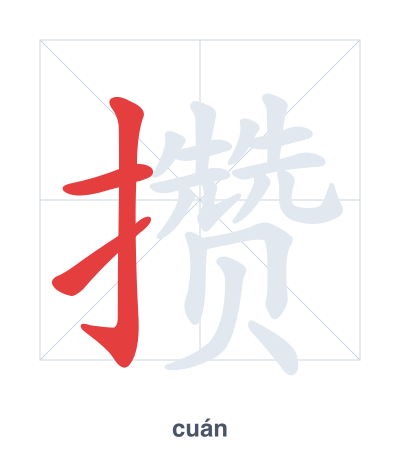
Open Hanzi Writer to see the animated stroke order and practice writing 攒 with real-time feedback.
The character 攒 (cuán/zǎn) is written with 19 strokes. Follow the standard Chinese stroke order: top to bottom, left to right, outside before inside. The radical 扌 is one of its key components.
Practice the correct stroke order with the Hanzi Writer app to see animated stroke-by-stroke guidance with real-time feedback.
攒 means to save money or assemble.
This is a polyphonic character with readings: cuán, zǎn.
As an HSK Level 7 character, 攒 is an intermediate-level character.
攒 combines the hand radical 扌 (action of gathering) with 赞 (zàn, meaning 'to assist' or 'to praise'), suggesting hands working together to collect or assemble things, like saving coins one by one.
💡 Memory Tip: Imagine your hand (扌) carefully stacking coins while a friend cheers (赞) you on as you save up for a big purchase.
我在攒钱买电脑。
wǒ zài zǎn qián mǎi diàn nǎo
I am saving money to buy a computer.
他积攒了很多经验。
tā jī zǎn le hěn duō jīng yàn
He has accumulated a lot of experience.
人群攒聚在广场上。
rén qún cuán jù zài guǎng chǎng shàng
The crowd gathered on the square.
Open Hanzi Writer to see the animated stroke order and practice writing 攒 with real-time feedback.
✨ Animated stroke order · Handwriting recognition · HSK-graded practice · Free to use
攒 is composed of the radical 扌 (hand) on the left and the character 赞 (zàn) on the right. The hand radical suggests a manual action, while 赞 provides a phonetic hint and also implies the idea of gathering or assisting, which connects to the meanings of saving money or assembling. Together, the structure shows that 攒 involves using your hands to collect or accumulate things.