攀 (pān) means "to climb or pull down" in Chinese. It has 19 strokes with the radical 手, and is HSK Level 7.
Rated 4.2/5 in difficulty (advanced).
Harder than 61% of HSK Level 7 characters.
Appears in 3+ common words including 攀登 (pān dēng), 攀谈 (pān tán), 攀比 (pān bǐ).
Due to its 19 strokes, Hanzi Writer's error detection shows 攀 requires focused practice — most learners need 10+ attempts for consistent accuracy.
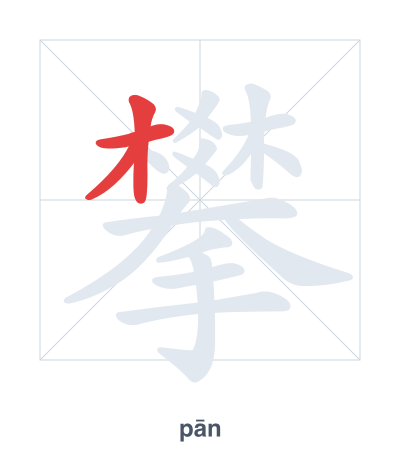
Open Hanzi Writer to see the animated stroke order and practice writing 攀 with real-time feedback.
The character 攀 (pān) is written with 19 strokes. Follow the standard Chinese stroke order: top to bottom, left to right, outside before inside. The radical 手 is one of its key components.
Practice the correct stroke order with the Hanzi Writer app to see animated stroke-by-stroke guidance with real-time feedback.
攀 means to climb or pull down.
As an HSK Level 7 character, 攀 is an intermediate-level character.
攀 combines 手 (hand) with 樊 (a fence or cage), suggesting using hands to pull oneself up over an obstacle. The top part 樊 originally depicted a fence made of intertwined branches, reinforcing the idea of climbing a structure.
💡 Memory Tip: Imagine two hands (two 木 in 樊) gripping a fence as you pull yourself up with your hand (手) to climb over it.
我们去攀登那座高山。
wǒ men qù pān dēng nà zuò gāo shān
Let's go climb that high mountain.
他喜欢和邻居攀谈。
tā xǐ huān hé lín jū pān tán
He likes chatting with his neighbors.
孩子们不要互相攀比。
hái zi men bú yào hù xiāng pān bǐ
Children should not compare themselves with each other.
Open Hanzi Writer to see the animated stroke order and practice writing 攀 with real-time feedback.
✨ Animated stroke order · Handwriting recognition · HSK-graded practice · Free to use
The character 攀 combines the component 樊 (fán, meaning a fence or intertwined structure) on top and the radical 手 (hand) at the bottom. This structure suggests using your hands to climb over or pull on an obstacle like a fence. The top part also includes 林 (forest) and 大 (big), hinting at climbing through dense trees or large objects.