Hanzi Writer

How to Write 孽 (niè) — Meaning “Sin; evil; calamity.”

niè 19 strokes Radical: 子

孽 (niè) means "Sin; evil; calamity." in Chinese. It has 19 strokes with the radical 子.

Rated 4.2/5 in difficulty (advanced).

Appears in 3+ common words including 罪孽 (zuì niè), 孽缘 (niè yuán), 作孽 (zuò niè).

Due to its 19 strokes, Hanzi Writer's error detection shows 孽 requires focused practice — most learners need 10+ attempts for consistent accuracy.
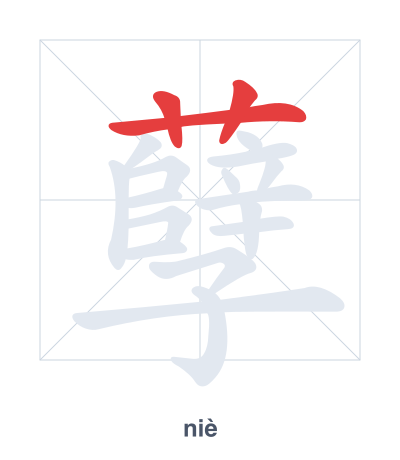
Stroke order practice for 孽 - niè

Practice Writing 孽 (niè)

Open Hanzi Writer to see the animated stroke order and practice writing 孽 with real-time feedback.

The character (niè) is written with 19 strokes. Follow the standard Chinese stroke order: top to bottom, left to right, outside before inside. The radical is one of its key components.

Practice the correct stroke order with the Hanzi Writer app to see animated stroke-by-stroke guidance with real-time feedback.

means Sin; evil; calamity..

Character
Pinyinniè (nie)
MeaningSin; evil; calamity.
Strokes19
Radical
Difficulty4.2/5

孽 combines the phonetic component 薛 (xuē) with the radical 子 (child). It originally referred to a child born from improper relations, thus extending to the concepts of sin, evil, and calamity.

💡 Memory Tip: Picture a child (子) born from a criminal act (辟) under a cover of grass (艹) - that sinful offspring is 孽.

zuì niè
Sin; retribution; karma
niè yuán
An ill-fated relationship.
zuò niè
to commit a sin; to do evil

他觉得这是罪孽。

tā jué de zhè shì zuì niè

He feels this is a sin.

这是他们的孽缘。

zhè shì tā men de niè yuán

This is their ill-fated relationship.

这样做真是作孽。

zhè yàng zuò zhēn shì zuò niè

Doing this is truly a sin.

Character Pinyin Strokes Radical
(current) niè 19
17
Stroke order practice for 孽 - niè

Practice Writing 孽 (niè)

Open Hanzi Writer to see the animated stroke order and practice writing 孽 with real-time feedback.

✨ Animated stroke order · Handwriting recognition · HSK-graded practice · Free to use

Frequently Asked Questions about 孽

孽 combines the bottom radical 子 (child) with a complex top part 薛 (xuē). The 子 component originally referred to offspring, and the whole character evolved from meaning "illegitimate child" to "sin" or "calamity." The top part provides the sound and adds a sense of complication or misfortune.

Characters with Radical 子

Other 19-Stroke Characters