瀚 (hàn) means "vast; extensive" in Chinese. It has 19 strokes with the radical 氵.
Rated 4.2/5 in difficulty (advanced).
Appears in 3+ common words including 浩瀚 (hào hàn), 瀚海 (hàn hǎi), 瀚漠 (hàn mò).
Due to its 19 strokes, Hanzi Writer's error detection shows 瀚 requires focused practice — most learners need 10+ attempts for consistent accuracy.
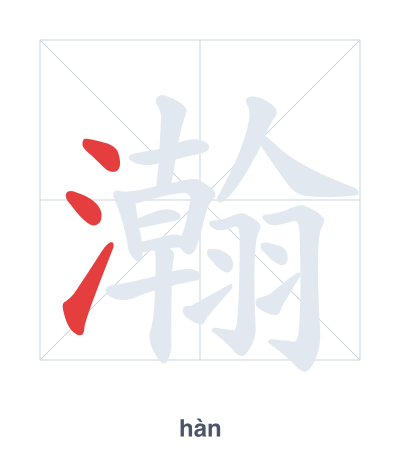
Open Hanzi Writer to see the animated stroke order and practice writing 瀚 with real-time feedback.
The character 瀚 (hàn) is written with 19 strokes. Follow the standard Chinese stroke order: top to bottom, left to right, outside before inside. The radical 氵 is one of its key components.
Practice the correct stroke order with the Hanzi Writer app to see animated stroke-by-stroke guidance with real-time feedback.
瀚 means vast; extensive.
瀚 is a phono-semantic compound. The radical 氵 (water) evokes a vast expanse of water, while 翰 (hàn, originally a long feather) provides the sound and hints at breadth, as a feather stretches wide. Together, 瀚 describes an immense, water-like scale—like an ocean's breadth.
💡 Memory Tip: Imagine a giant feather (翰) floating on an endless ocean (氵), stretching from horizon to horizon—a truly vast, 瀚 scene.
大海非常浩瀚。
dà hǎi fēi cháng hào hàn
The sea is very vast.
他走进了瀚海沙漠。
tā zǒu jìn le hàn hǎi shā mò
He entered the vast desert.
瀚漠里没有水源。
hàn mò lǐ méi yǒu shuǐ yuán
There is no water source in the vast desert.
Open Hanzi Writer to see the animated stroke order and practice writing 瀚 with real-time feedback.
✨ Animated stroke order · Handwriting recognition · HSK-graded practice · Free to use
瀚 is made of the water radical 氵 on the left and the character 翰 (hàn, meaning 'long feather' or 'writing brush') on the right. The water radical hints at large bodies of water, while 翰 gives the sound and adds the sense of something long or far-reaching, together conveying the idea of 'vast' or 'extensive'.