垫 (diàn) means "pad; cushion; to fill" in Chinese. It has 9 strokes with the radical 土, and is HSK Level 7.
Rated 4/5 in difficulty (challenging).
Harder than 39% of HSK Level 7 characters.
Appears in 3+ common words including 垫子 (diàn zi), 床垫 (chuáng diàn), 鞋垫 (xié diàn).
Due to its 9 strokes, Hanzi Writer's error detection shows 垫 requires focused practice — most learners need 10+ attempts for consistent accuracy.
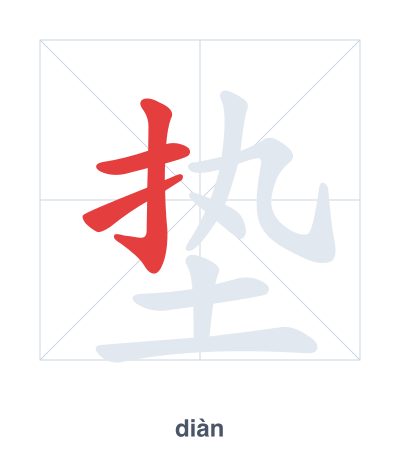
Open Hanzi Writer to see the animated stroke order and practice writing 垫 with real-time feedback.
The character 垫 (diàn) is written with 9 strokes. Follow the standard Chinese stroke order: top to bottom, left to right, outside before inside. The radical 土 is one of its key components.
Practice the correct stroke order with the Hanzi Writer app to see animated stroke-by-stroke guidance with real-time feedback.
垫 means pad; cushion; to fill.
As an HSK Level 7 character, 垫 is an intermediate-level character.
垫 is a phono-semantic compound: the radical 土 (earth) indicates the material used for padding or filling, while the phonetic component 执 (zhí, meaning 'to hold') suggests the action of placing or supporting. Originally, it referred to using earth or soft material to level a surface or cushion an object.
💡 Memory Tip: Picture yourself holding (执) a clump of earth (土) to use as a cushion for a hard chair.
椅子上有个垫子。
yǐ zi shàng yǒu gè diàn zi
There is a cushion on the chair.
这个床垫很舒服。
zhè ge chuáng diàn hěn shū fú
This mattress is very comfortable.
我买了一双鞋垫。
wǒ mǎi le yī shuāng xié diàn
I bought a pair of insoles.
Open Hanzi Writer to see the animated stroke order and practice writing 垫 with real-time feedback.
✨ Animated stroke order · Handwriting recognition · HSK-graded practice · Free to use
The character 垫 combines the radical 土 (earth, soil) on top and 执 (to hold, to execute) below. The soil radical suggests something related to the ground or a surface, while 执 implies the action of placing or filling, together forming the idea of a "pad" or "cushion" that sits on the ground.