址 (zhǐ) means "Site / Address / Location" in Chinese. It has 7 strokes with the radical 土, and is HSK Level 4.
Rated 3.5/5 in difficulty (challenging).
Harder than 30% of HSK Level 4 characters.
Appears in 3+ common words including 地址 (dì zhǐ), 网址 (wǎng zhǐ), 遗址 (yí zhǐ).
Due to its 7 strokes, Hanzi Writer's error detection shows 址 requires focused practice — most learners need 10+ attempts for consistent accuracy.
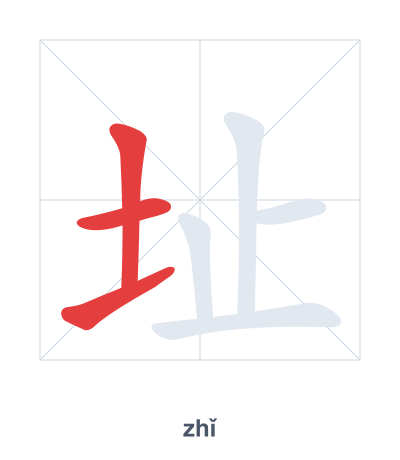
Open Hanzi Writer to see the animated stroke order and practice writing 址 with real-time feedback.
The character 址 (zhǐ) is written with 7 strokes. Follow the standard Chinese stroke order: top to bottom, left to right, outside before inside. The radical 土 is one of its key components.
Practice the correct stroke order with the Hanzi Writer app to see animated stroke-by-stroke guidance with real-time feedback.
址 means Site / Address / Location.
As an HSK Level 4 character, 址 is an intermediate-level character.
址 combines the radical 土 (earth/ground) with 止 (stop/foot), suggesting a place where one stops or builds on the ground—hence a site or address.
💡 Memory Tip: Picture yourself stopping (止) on a patch of ground (土) to mark the exact location of your new home.
请写下你的地址。
qǐng xiě xià nǐ de dì zhǐ
Please write down your address.
这个网址打不开。
zhè ge wǎng zhǐ dǎ bù kāi
This URL cannot be opened.
我们去参观遗址。
wǒ men qù cān guān yí zhǐ
We are going to visit the ruins.
Open Hanzi Writer to see the animated stroke order and practice writing 址 with real-time feedback.
✨ Animated stroke order · Handwriting recognition · HSK-graded practice · Free to use
址 is composed of 土 (earth/ground) on the left and 止 (stop) on the right. Together, they suggest a place where something is stopped or fixed on the ground, giving the meaning "site" or "location." The 土 radical hints at land or place, while 止 originally provided sound and now adds the idea of a fixed point.