圻 (qí) means "Border / Boundary" in Chinese. It has 7 strokes with the radical 土.
Rated 3.5/5 in difficulty (challenging).
Appears in 3+ common words including 圻岸 (qí àn), 圻甸 (qí diān), 郊圻 (jiāo qí).
Due to its 7 strokes, Hanzi Writer's error detection shows 圻 requires focused practice — most learners need 10+ attempts for consistent accuracy.
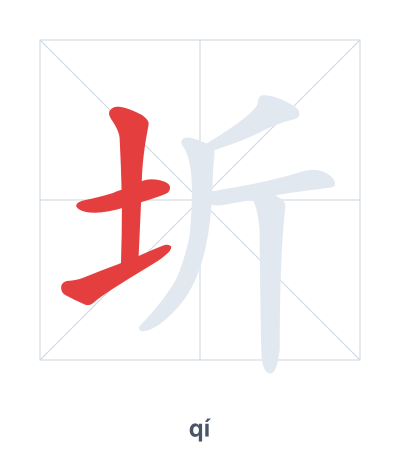
Open Hanzi Writer to see the animated stroke order and practice writing 圻 with real-time feedback.
The character 圻 (qí) is written with 7 strokes. Follow the standard Chinese stroke order: top to bottom, left to right, outside before inside. The radical 土 is one of its key components.
Practice the correct stroke order with the Hanzi Writer app to see animated stroke-by-stroke guidance with real-time feedback.
圻 means Border / Boundary.
圻 combines 土 (earth/ground) and 斤 (axe). The axe (斤) was used to cut or mark the earth (土), creating a visible boundary or border. This compound illustrates the ancient practice of using tools to delineate territory in the soil.
💡 Memory Tip: Imagine an axe (斤) striking the ground (土) to carve a sharp line—that's the border where your land ends and another's begins.
他在圻岸边散步。
tā zài qí àn biān sàn bù
He is walking along the riverbank.
这是古代的圻甸。
zhè shì gǔ dài de qí diān
This is the ancient royal domain.
郊圻的景色很美。
jiāo qí de jǐng sè hěn měi
The scenery in the outskirts is very beautiful.
Open Hanzi Writer to see the animated stroke order and practice writing 圻 with real-time feedback.
✨ Animated stroke order · Handwriting recognition · HSK-graded practice · Free to use
The character 圻 is made of two parts: the left side is 土 (earth/soil) and the right side is 斤 (axe). Since a border or boundary is often marked on land, 土 shows the element of land, while 斤 hints at cutting or dividing the land to create a boundary line.