圼 (niè) means "To fill / To block" in Chinese. It has 7 strokes with the radical 土.
Rated 3.5/5 in difficulty (challenging).
Appears in 3+ common words including 圼土 (niè tǔ), 圼塞 (niè sāi), 圼合 (niè hé).
Due to its 7 strokes, Hanzi Writer's error detection shows 圼 requires focused practice — most learners need 10+ attempts for consistent accuracy.
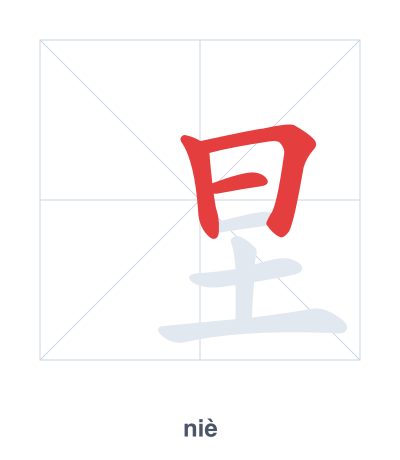
Open Hanzi Writer to see the animated stroke order and practice writing 圼 with real-time feedback.
The character 圼 (niè) is written with 7 strokes. Follow the standard Chinese stroke order: top to bottom, left to right, outside before inside. The radical 土 is one of its key components.
Practice the correct stroke order with the Hanzi Writer app to see animated stroke-by-stroke guidance with real-time feedback.
圼 means To fill / To block.
圼 combines the radical 土 (earth) with 曰 (a mouth or opening), suggesting the act of plugging or filling a cavity with earth to block it. This visual metaphor directly conveys the meaning of 'to fill' or 'to block'.
💡 Memory Tip: Picture using a handful of dirt (土) to jam into a mouth (曰) to block it completely.
这里有很多圼土。
zhè lǐ yǒu hěn duō niè tǔ
There is a lot of black soil here.
水管被圼塞了。
shuǐ guǎn bèi niè sāi le
The water pipe is clogged.
两种颜色圼合了。
liǎng zhǒng yán sè niè hé le
The two colors blended together.
Open Hanzi Writer to see the animated stroke order and practice writing 圼 with real-time feedback.
✨ Animated stroke order · Handwriting recognition · HSK-graded practice · Free to use
圼 is made of 土 (earth) on top and 日 (sun) below. This structure suggests using earth to cover or block something, like filling a hole to block sunlight. The radicals directly support the meanings of filling and blocking.