床 (chuáng) means "bed" in Chinese. It has 7 strokes with the radical 广, and is HSK Level 1.
Rated 2.9/5 in difficulty (moderate).
Harder than 54% of HSK Level 1 characters.
Appears in 3+ common words including 起床 (qǐ chuáng), 床上 (chuáng shàng), 单人床 (dān rén chuáng).
Hanzi Writer's stroke validation shows learners typically need 5-8 attempts to write 床 with correct proportion and order.
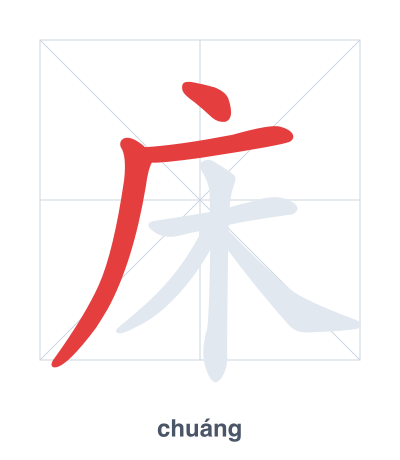
Open Hanzi Writer to see the animated stroke order and practice writing 床 with real-time feedback.
The character 床 (chuáng) is written with 7 strokes. Follow the standard Chinese stroke order: top to bottom, left to right, outside before inside. The radical 广 is one of its key components.
Practice the correct stroke order with the Hanzi Writer app to see animated stroke-by-stroke guidance with real-time feedback.
床 means bed.
As an HSK Level 1 character, 床 is among the first characters beginners learn.
The character 床 combines the radical 广 (shelter) with 木 (wood), suggesting a wooden bed placed under a roof. Its ancient form depicted a simple wooden frame for sleeping, emphasizing the material and location.
💡 Memory Tip: Picture a wooden plank (木) under a roof-like canopy (广) — that's where you lay your bed.
我每天七点起床。
wǒ měi tiān qī diǎn qǐ chuáng
I get up at seven every day.
手机在床上。
shǒu jī zài chuáng shàng
The phone is on the bed.
这是一张单人床。
zhè shì yī zhāng dān rén chuáng
This is a single bed.
Open Hanzi Writer to see the animated stroke order and practice writing 床 with real-time feedback.
✨ Animated stroke order · Handwriting recognition · HSK-graded practice · Free to use
床 is made of two parts: the radical 广 (which often indicates a building or shelter) and 木 (wood). Together, they suggest a wooden sleeping platform under a roof, which represents a bed.